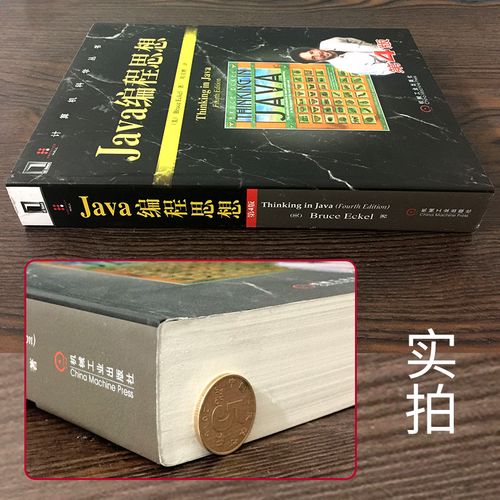
Of course! "Thinking in Java, 4th Edition" by Bruce Eckel is a landmark book in the world of Java programming. It's famous for its depth, its focus on fundamental concepts, and its "thinking" approach to teaching.
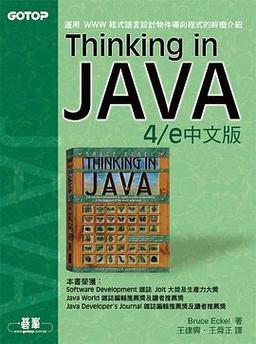
Let's break down what makes this book so significant, its key features, who it's for, and where it stands today.
The Core Philosophy: "Thinking in Java"
isn't just a catchy phrase; it's the book's central mission. Eckel's goal is not just to teach you Java syntax but to teach you how to think like a Java programmer.
This means:
- Focus on Fundamentals: It starts from the ground up, ensuring you have a rock-solid understanding of core concepts like objects, polymorphism, and memory management before moving to more advanced topics.
- Why, Not Just How: The book explains the reasoning behind language design decisions. Why do we have interfaces? Why are generics useful? This deeper understanding helps you write better, more robust, and more idiomatic code.
- Comparative Approach: Eckel often compares Java to C and C++, which helps programmers coming from those backgrounds understand what Java does differently and why (e.g., automatic memory management, the absence of pointers).
- Encourages Good Habits: The book emphasizes best practices, design patterns, and clean code from the very beginning.
Key Features and Content (4th Edition Highlights)
The 4th Edition was a major update, covering Java 5 and Java 6, which introduced some of the most significant features in the language's history.
Major New Features in Java 5/6 Covered:
- Generics: This was a huge addition. Eckel dedicates significant space to explaining how generics allow for type-safe collections and APIs, preventing
ClassCastExceptionat runtime. He covers the syntax, the wildcard (), and the sometimes confusing concept of type erasure. - Annotations (Metadata): The book explains how annotations (like
@Override,@Deprecated, and custom annotations) allow you to embed metadata directly in your code. This is the foundation for many modern frameworks (like Spring, JUnit, etc.). - Enums: It covers the new
enumkeyword, which provides a much more powerful and type-safe way to create enumerated types than the old, simple integer-based approach. - Autoboxing/Auto-unboxing: The book details the automatic conversion between primitive types (like
int) and their object wrapper counterparts (likeInteger). This simplifies code but also introduces potential pitfalls (likenullpointer exceptions on unboxing). - Enhanced
for-loop (for-each): It explains the new, cleaner syntax for iterating over arrays and collections, which has become a standard in modern Java. - Static Import: A feature that allows you to import static members of a class (like constants from
MathorSystem) directly into the namespace, reducing boilerplate code.
Core Traditional Topics (Covered in Depth):
- The Object-Oriented Paradigm: A thorough grounding in objects, classes, inheritance, and polymorphism.
- Error Handling with Exceptions: Deep dive into
try-catch-finally, checked vs. unchecked exceptions, and best practices for exception handling. - I/O (Input/Output): Covers the Java I/O streams, NIO (New I/O), and file manipulation.
- Concurrency (Multithreading): A comprehensive chapter on threads, synchronization, the
synchronizedkeyword, and thejava.util.concurrentutilities. - GUI with Swing: A detailed look at building graphical user interfaces using the Swing toolkit.
- Network Programming: Covers sockets, TCP/IP, and URL communication.
Who Is This Book For?
Despite its age, the book's focus on fundamentals gives it a specific audience.
It's an excellent choice for:
- Programmers new to Java: If you have experience in another object-oriented language (like C++ or C#), this book will bridge the gap perfectly. If you're coming from a non-OO background, its patient explanations of OO concepts are invaluable.
- Experienced C/C++ Programmers: The comparative sections are pure gold for understanding Java's design philosophy and how it avoids the pitfalls of C/C++.
- Developers who want to solidify their fundamentals: If you've been using Java for a while but feel shaky on core concepts like polymorphism or the mechanics of the JVM, this book is a fantastic refresher.
- Students: It's often used as a textbook in university computer science courses because of its rigorous and comprehensive nature.
It might NOT be the best choice for:
- Absolute beginners with no programming experience: The pace can be fast, and the OO concepts might be overwhelming without some prior exposure to basic programming logic.
- Developers looking for a quick-start guide to modern Java (Java 8+): While the 4th edition's core is timeless, it predates lambdas, streams, the
java.timeAPI, and other major features of modern Java. You would need a supplementary resource for those.
Strengths and Weaknesses
Strengths:
- Depth and Rigor: It goes deeper than most introductory books.
- Clarity of Explanation: Eckel is known for his clear, patient, and often witty writing style.
- Excellent Examples: The code examples are well-chosen to illustrate the concepts being discussed.
- Focus on the "Why": It builds a strong mental model of the language.
- Free Availability: Eckel makes the book available for free on his website, which is a huge plus.
Weaknesses (Especially Today):
- Dated API Examples: While the core concepts are timeless, many examples use older APIs that are now superseded (e.g., older GUI practices, older I/O methods).
- No Coverage of Modern Java Features: As mentioned, it has no information on Java 8 (Lambdas, Streams), Java 9-21 (Modules, Records, Sealed Classes, Virtual Threads, etc.). This is its biggest drawback for anyone starting today.
- Pacing: Some find the pace to be slow and deliberate, which can be a pro or a con depending on your learning style.
"Thinking in Java" in the Modern Era (2025)
Is it still relevant? Absolutely, but with a major caveat.
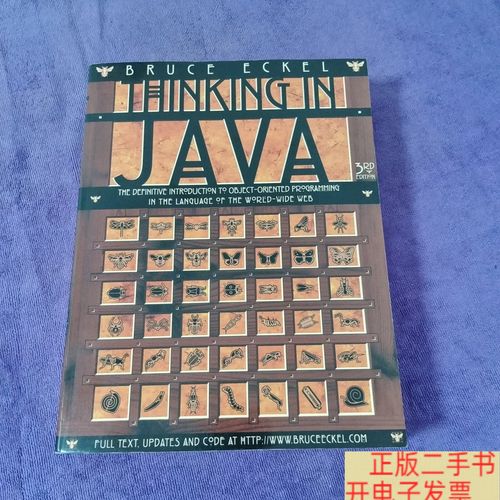
Think of "Thinking in Java, 4th Edition" as the "Old Testament" of Java books. It provides the foundational laws, principles, and deep understanding upon which everything else is built. The core concepts of objects, threads, and the JVM haven't changed.
How to use it today:
- For Foundational Knowledge: Read it to build an unshakable understanding of object-oriented programming and the Java language's core mechanics.
- As a Reference: When you're confused about a fundamental concept (e.g., "What is polymorphism again?" or "How exactly does garbage collection work?"), this book is an excellent resource.
- Pair It with a Modern Resource: The best approach is to use "Thinking in Java" for the "thinking" part and a more modern book or online course for the "doing" part in the current ecosystem.
Modern Alternatives for Comparison:
- "Java: A Beginner's Guide" by Herbert Schildt: A more traditional, step-by-step introduction that covers up-to-date Java features.
- "Core Java, Volume I--Fundamentals" by Cay S. Horstmann: A modern, comprehensive, and highly regarded series that covers the latest Java versions.
- Online Courses (e.g., on Coursera, Pluralsight, Udemy): Excellent for getting hands-on with modern features like lambdas and streams.
Final Verdict
"Thinking in Java, 4th Edition" is a masterpiece. It's not the most current book, but its focus on timeless principles and its deep, thoughtful explanations make it an enduring classic. If you want to truly master the fundamentals of Java and understand the language on a deeper level, it is still one of the best books you can read. Just be prepared to supplement it with resources that cover Java 8 and beyond.