Of course! Finding words in Python is a common task, but the exact method depends heavily on what you mean by "find words".
Let's break it down into the most common scenarios, from simple to more complex.
Scenario 1: Find a Specific Word in a String
You have a block of text and you want to check if a particular word exists in it.
Method A: Using the in operator (Simple and Common)
This is the most straightforward way. It checks for the substring, not necessarily a whole word.
text = "The quick brown fox jumps over the lazy dog."
word_to_find = "fox"
if word_to_find in text:
    print(f"Yes, the word '{word_to_find}' is in the text.")
else:
    print(f"No, the word '{word_to_find}' is not in the text.")
# Example of a substring match
word_to_find = "row"
if word_to_find in text:
    print(f"Warning: '{word_to_find}' is a substring of 'brown', not a whole word.")
Method B: Using Regular Expressions for "Whole Word" Matching
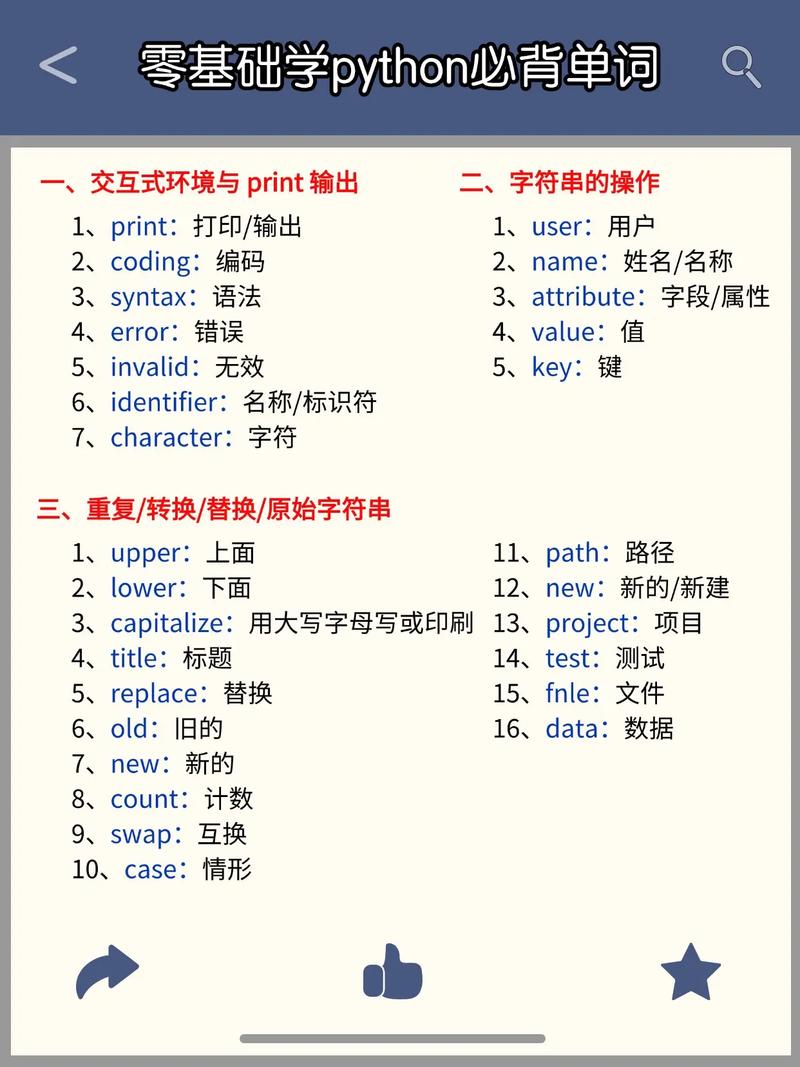
If you need to find a word only when it appears as a whole word (not as part of another word), regular expressions are the best tool. The \b metacharacter matches a "word boundary".
import re
text = "The fox is cunning, but the foxy dog is not."
word_to_find = "fox"
# re.search() finds the first occurrence
match = re.search(rf'\b{word_to_find}\b', text)
if match:
    print(f"Yes, the whole word '{word_to_find}' was found at position {match.start()}.")
else:
    print(f"No, the whole word '{word_to_find}' was not found.")
# Example where it fails for "foxy"
match_foxy = re.search(rf'\bfoxy\b', text)
if not match_foxy:
    print("As expected, 'foxy' was not found because it's part of a larger word.")
Scenario 2: Find All Occurrences of a Word in a String
You want to find every instance of a word, including how many times it appears.
Method A: Using str.count() (For Simple Substrings)
This counts how many times a substring appears.
text = "The dog is a good dog. A very good dog."
substring = "dog"
count = text.count(substring)
print(f"The substring '{substring}' appears {count} times.")
Method B: Using re.findall() (For Whole Words)
This is the most powerful way to find all whole-word matches and get their locations or the actual words found.
import re
text = "The cat sat on the mat. The cat was happy."
word_to_find = "cat"
# Find all occurrences as a list of strings
all_occurrences = re.findall(rf'\b{word_to_find}\b', text)
print(f"All occurrences of '{word_to_find}': {all_occurrences}")
print(f"It was found {len(all_occurrences)} times.")
# Find all occurrences and their start/end positions
for match in re.finditer(rf'\b{word_to_find}\b', text):
    print(f"Found '{match.group()}' at index {match.start()} to {match.end()}")
Scenario 3: Find All Unique Words in a String
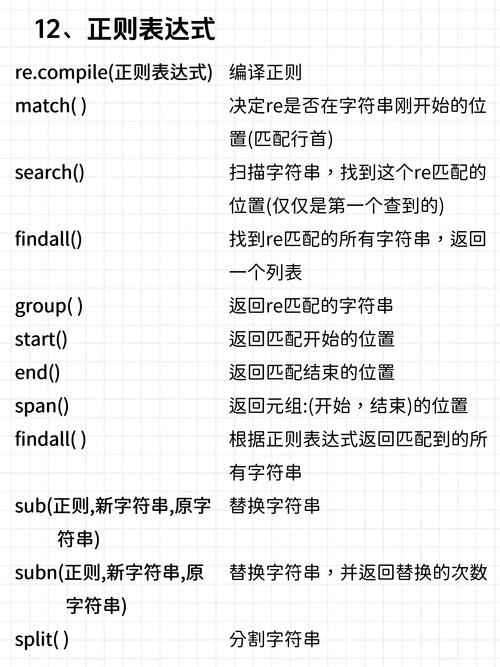
You want to extract a list of every distinct word used in a piece of text.
This process usually involves:
- Cleaning the text: Removing punctuation.
- Splitting the text: Breaking it into a list of words.
- Storing unique words: Using a
setto automatically handle uniqueness.
import string
text = "Hello world! This is a test. Hello again, world."
# 1. Remove punctuation
# string.punctuation contains '!"#$%&\'()*+,-./:;<=>?@[\\]^_`{|}~'
text_no_punct = text.translate(str.maketrans('', '', string.punctuation))
# 2. Split into words (lowercase to make "Hello" and "hello" the same)
words = text_no_punct.lower().split()
# 3. Get unique words by converting the list to a set
unique_words = set(words)
print(f"Original words: {words}")
print(f"Unique words: {sorted(list(unique_words))}") # sorted() for a clean list
Scenario 4: Find Words Matching a Pattern
You're not looking for a specific word, but for words that fit a certain pattern (e.g., all words starting with 's', or all 7-letter words).
This is a classic job for regular expressions.
import re
text = "Python is a fantastic programming language. It is versatile and powerful."
# Find all words that start with 'p'
p_words = re.findall(r'\bp\w*', text)
print(f"Words starting with 'p': {p_words}")
# Find all words that are exactly 5 letters long
five_letter_words = re.findall(r'\b\w{5}\b', text)
print(f"5-letter words: {five_letter_words}")
# Find all words that start with a capital letter
capital_words = re.findall(r'\b[A-Z]\w*', text)
print(f"Words starting with a capital: {capital_words}")
Scenario 5: Find Words in a File
You want to search for words within the contents of a text file (e.g., my_document.txt).
This combines file I/O with the string searching methods above.
import re
def find_word_in_file(filename, word_to_find):
    """Finds a whole word in a file and prints its line number."""
    try:
        with open(filename, 'r') as f:
            for line_num, line in enumerate(f, 1): # enumerate starts counting at 1
                if re.search(rf'\b{word_to_find}\b', line):
                    print(f"Found '{word_to_find}' on line {line_num}: {line.strip()}")
    except FileNotFoundError:
        print(f"Error: The file '{filename}' was not found.")
# --- Example Usage ---
# First, let's create a dummy file to search
with open("my_document.txt", "w") as f:
    f.write("This is the first line.\n")
    f.write("The second line contains the word example.\n")
    f.write("This is the final line, with another example.\n")
# Now, search for the word "example"
find_word_in_file("my_document.txt", "example")
Summary: Which Method to Use?
| Your Goal | Best Python Tool | Why? |
|---|---|---|
| Is a word in a string? | if "word" in my_string: |
Simple, readable, and fast. |
| Is a whole word in a string? | re.search(r'\bword\b', my_string) |
Accurately distinguishes "cat" from "caterpillar". |
| How many times does a word appear? | re.findall(r'\bword\b', my_string) |
Returns a list of all matches, from which you can get the count. |
| Get a list of all unique words | set(my_string.translate(...).lower().split()) |
A set is the most efficient way to store unique items. |
| Find words that match a pattern (e.g., start with 's') | re.findall(r'\bs\w*', my_string) |
Regular expressions are designed for flexible pattern matching. |
| Search for a word in a file | re.search() inside a for loop that reads the file |
This is the standard, memory-efficient way to process files line by line. |