Of course! Let's dive deep into WebDriverWait in Python, which is a crucial part of writing robust and reliable automated tests with Selenium.
What is WebDriverWait?
WebDriverWait is a part of Selenium's Explicit Waits mechanism. In simple terms, it's a smart way to tell your script to pause and wait for a certain condition to be met before proceeding, with a maximum timeout limit.
This is the opposite of Implicit Waits, which tell the driver to poll the DOM for a certain amount of time to find any element. While simple, implicit waits can hide problems and slow down your tests.
Why is WebDriverWait so important?
Modern web applications are dynamic. Elements appear, disappear, and change state based on user actions, network requests, and JavaScript. A script that runs too fast might try to interact with an element before it's visible, clickable, or even present in the DOM, leading to flaky and unreliable tests. WebDriverWait solves this by making your tests wait intelligently.
The Core Concept: WebDriverWait and expected_conditions
WebDriverWait works in conjunction with expected_conditions. You tell WebDriverWait what condition you're waiting for, and it will repeatedly check for that condition until it's true or until the timeout is reached.
The Syntax
The general structure is:
from selenium.webdriver.support.ui import WebDriverWait
from selenium.webdriver.support import expected_conditions as EC
from selenium.webdriver.common.by import By
# ... (your driver setup) ...
# Wait up to 10 seconds for an element with ID 'myDynamicElement' to be visible
try:
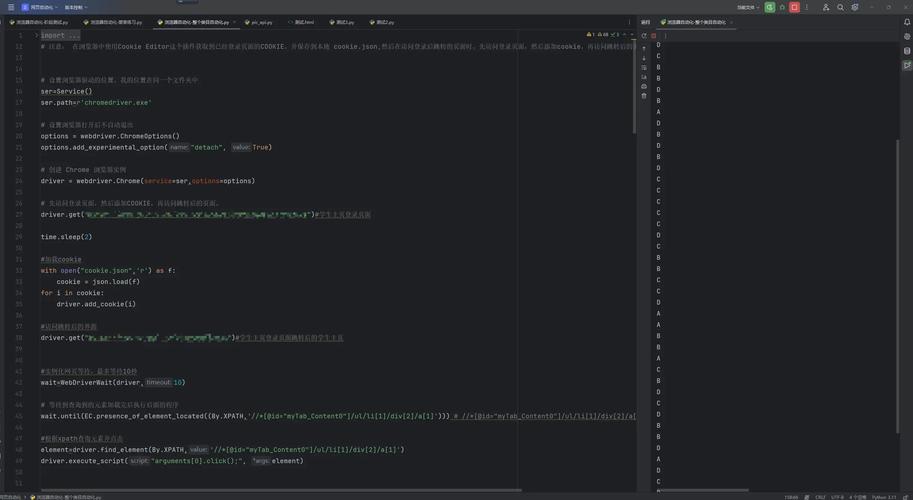
    element = WebDriverWait(driver, 10).until(
        EC.visibility_of_element_located((By.ID, "myDynamicElement"))
    )
    # Now you can interact with the element
    element.click()
except TimeoutException:
    # Handle the case where the element was not found within the timeout
    print("Element did not appear within 10 seconds")
How it Works (The Polling Mechanism)
- Initialization:
WebDriverWait(driver, 10)creates a wait object that will wait for a maximum of 10 seconds. - Polling: The
until()method starts checking the condition (e.g.,EC.visibility_of_element_located). - Frequency: It checks the condition every 500 milliseconds by default. This is configurable.
- Success: If the condition becomes true before the 10-second timeout,
until()returns the result of the condition (usually the WebElement itself), and your script continues. - Failure: If the 10-second timeout is reached and the condition is still false,
until()raises aTimeoutException.
Common expected_conditions
The selenium.webdriver.support.expected_conditions module provides a rich set of pre-built conditions. Here are the most commonly used ones:
| Condition | Description | Example |
|---|---|---|
visibility_of_element_located((By, 'locator')) |
Waits for an element to be present in the DOM, visible, and have a height and width greater than 0. | EC.visibility_of_element_located((By.ID, "submit-button")) |
presence_of_element_located((By, 'locator')) |
Waits for an element to be present in the DOM (it doesn't have to be visible). | EC.presence_of_element_located((By.XPATH, "//div[@class='loading']")) |
element_to_be_clickable((By, 'locator')) |
Waits for an element to be visible and enabled, so you can click it. This is often the best condition for buttons. | EC.element_to_be_clickable((By.CSS_SELECTOR, ".login-btn")) |
invisibility_of_element_located((By, 'locator')) |
Waits for an element to no longer be attached to the DOM or to be hidden. Useful for waiting for loaders/spinners to disappear. | EC.invisibility_of_element_located((By.ID, "loading-spinner")) |
alert_is_present() |
Waits for a JavaScript alert to be present. | EC.alert_is_present() |
element_to_be_selected(element) |
Waits for an element (e.g., a checkbox or option) to be selected. | EC.element_to_be_selected(driver.find_element(By.ID, "remember-me")) |
Practical Example: Login Form
Let's imagine a login page where the "Submit" button is disabled initially and only becomes enabled after the user starts typing in the password field.
HTML Snippet:
<input type="text" id="username" placeholder="Username">
<input type="password" id="password" placeholder="Password">
<button id="submit-btn" disabled>Login</button>
Python Script:
from selenium import webdriver
from selenium.webdriver.common.by import By
from selenium.webdriver.support.ui import WebDriverWait
from selenium.webdriver.support import expected_conditions as EC
from selenium.common.exceptions import TimeoutException
# 1. Setup the driver
driver = webdriver.Chrome()
driver.get("https://example.com/login")
try:
    # 2. Find the username and password fields and interact with them
    username_field = driver.find_element(By.ID, "username")
    password_field = driver.find_element(By.ID, "password")
    username_field.send_keys("my_user")
    # 3. The crucial part: Wait for the button to become clickable
    # We will wait a maximum of 15 seconds
    print("Waiting for the submit button to become clickable...")
    submit_button = WebDriverWait(driver, 15).until(
        EC.element_to_be_clickable((By.ID, "submit-btn"))
    )
    # 4. If the wait succeeds, the button is clickable. Now we can click it.
    print("Button is clickable! Proceeding with click.")
    submit_button.click()
    # 5. Wait for the next page to load (e.g., by waiting for a new title)
    WebDriverWait(driver, 10).until(
        EC.title_contains("Dashboard")
    )
    print("Successfully logged in! Page title:", driver.title)
except TimeoutException:
    print("Error: Timed out waiting for an element. The page might not have loaded as expected.")
    # You can take a screenshot here for debugging
    driver.save_screenshot("error_screenshot.png")
finally:
    # 6. Always close the browser
    driver.quit()
Best Practices and Advanced Tips
-
Always Use
try...except TimeoutException: Your tests should be resilient. If an element doesn't appear, the test should fail gracefully with a clear message, not crash with an unhandled exception. -
Be Specific in Your Waits: Don't just wait for a generic element. Wait for the element to be in the state you need it in.
- Bad:
WebDriverWait(driver, 10).until(EC.presence_of_element_located((By.ID, "submit-btn"))) - Good:
WebDriverWait(driver, 10).until(EC.element_to_be_clickable((By.ID, "submit-btn"))) - Best:
WebDriverWait(driver, 10).until(EC.visibility_of_element_located((By.XPATH, "//button[contains(text(), 'Submit')]")))
- Bad:
-
Avoid Mixing Implicit and Explicit Waits: This is a common source of confusion and unpredictable behavior. If you have an implicit wait set (e.g.,
driver.implicitly_wait(10)), it will apply in addition to your explicit wait, effectively doubling the time. It's a best practice to avoid implicit waits altogether and rely solely on explicit waits (WebDriverWait). -
Custom Expected Conditions: What if you need a condition that doesn't exist? You can easily create your own by creating a function that takes a
driverargument and returnsFalseor the expected result.# Custom condition to wait for text in a specific element def text_in_element(locator, text_): def _predicate(driver): try: element = driver.find_element(*locator) return text_ in element.text except NoSuchElementException: return False return _predicate # Usage: WebDriverWait(driver, 10).until( text_in_element((By.ID, "status-message"), "Success!") ) -
Use
poll_frequency: If your application is slow or you want to optimize, you can change the polling interval.# Poll every 2 seconds instead of the default 0.5 WebDriverWait(driver, 10, poll_frequency=2).until(...)
Summary: Implicit Wait vs. Explicit Wait (WebDriverWait)
| Feature | Implicit Wait | Explicit Wait (WebDriverWait) |
|---|---|---|
| Scope | Applied to the entire driver instance for all find_element calls. |
Applied to a specific find_element call. |
| Behavior | Sets a default |