Of course! Here is a comprehensive introduction to Python, designed for someone who has never programmed before.
Introducing Python: The Language That Reads Like English
Imagine you could give a computer instructions using simple, clear English sentences. That's the feeling you get with Python. It's a powerful, popular, and beginner-friendly programming language known for its clean and readable syntax.
What is Python?
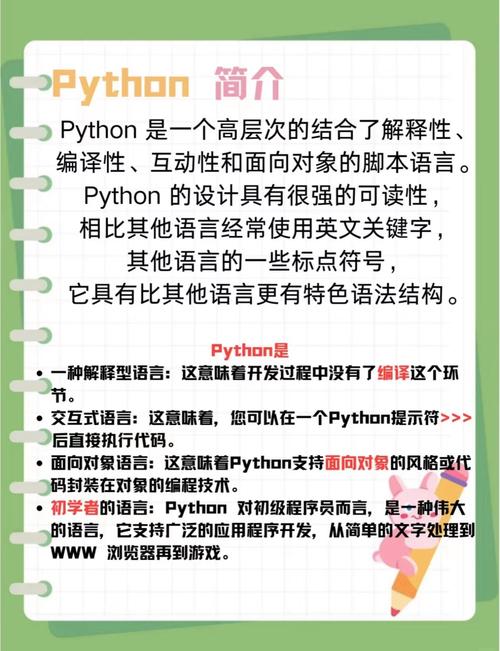
At its core, Python is a high-level, interpreted, general-purpose programming language.
Let's break that down:
- High-Level: It's designed to be easy for humans to understand. It handles complex, low-level details (like memory management) for you, so you can focus on solving problems.
- Interpreted: Instead of compiling your entire code into machine language all at once (like C++ or Java), Python executes it line by line. This makes it interactive and great for quick testing.
- General-Purpose: Python isn't limited to one task. You can use it to build websites, analyze data, create artificial intelligence, write scripts to automate tasks, and much more.
Why is Python So Popular?
Python's popularity isn't accidental. It's loved for several key reasons:
-
Readability and Simplicity: The syntax is clean and looks almost like plain English. This makes it one of the easiest languages for beginners to learn and reduces the time it takes to understand code.
# This is a Python comment print("Hello, World!") # This prints text to the screen -
Versatility (The "Swiss Army Knife" of Code): Python can do almost anything.
- Web Development: Frameworks like Django and Flask power websites like Instagram and Spotify.
- Data Science & Machine Learning: Libraries like Pandas, NumPy, and TensorFlow make it the go-to language for data analysis, visualization, and AI.
- Automation & Scripting: Automate boring tasks like renaming files, sending emails, or scraping data from websites.
- Game Development: Libraries like Pygame are used to create 2D games.
- Scientific Computing: Used in fields like engineering, physics, and finance for complex calculations.
-
Huge Community and Ecosystem: Python has one of the largest and most active communities in the world. This means:
- Tons of Tutorials: If you get stuck, you can find a solution for almost any problem online.
- Rich Libraries: The Python Package Index (PyPI) hosts hundreds of thousands of pre-built modules and packages that you can easily install to add functionality to your programs without writing everything from scratch.
-
Cross-Platform: Python runs on Windows, macOS, Linux, and even some mobile operating systems. Code you write on one machine will work on another without modification.
Python in Action: A Simple Example
Let's see what Python code looks like. We'll write a simple program that asks for your name and then greets you.
# 1. Get input from the user
# The input() function pauses the program and waits for the user to type something.
name = input("Please enter your name: ")
# 2. Process the input
# We use an f-string (formatted string) to easily insert the 'name' variable into our message.
greeting_message = f"Hello, {name}! Welcome to Python."
# 3. Display the output
# The print() function displays the message to the screen.
print(greeting_message)
How it works:
name = input(...): This line prompts the user with "Please enter your name: " and whatever the user types is stored in a variable calledname.greeting_message = f"...": This creates a new string. Thefbefore the quote tells Python to treat the curly braces as placeholders for variables.print(...): This is the simplest way to output information.
Key Concepts You'll Learn
As you start learning Python, you'll encounter these fundamental building blocks:
- Variables: Containers for storing data (e.g.,
age = 25,city = "New York"). - Data Types: The kind of data a variable can hold.
- Numbers:
int(integers like 10),float(decimals like 3.14). - Strings: Text, like
"Hello". - Booleans: Representing truth values,
TrueorFalse.
- Numbers:
- Operators: Symbols that perform operations (e.g., for addition, for comparison).
- Control Flow: Making decisions in your code.
if/elif/elsestatements: For conditional logic.- Loops: For repeating tasks (e.g.,
forloops,whileloops).
- Functions: Reusable blocks of code that perform a specific task (e.g.,
print()is a built-in function). - Data Structures: Ways to organize and store collections of data.
- Lists: An ordered, changeable collection (e.g.,
[1, 2, 3]). - Dictionaries: A collection of key-value pairs (e.g.,
{"name": "Alice", "age": 30}).
- Lists: An ordered, changeable collection (e.g.,
- Modules and Libraries: Files containing pre-written code that you can import to use in your own programs (e.g.,
import mathto use math functions).
How to Get Started
Getting started with Python is incredibly easy and free.
- Install Python: Go to the official Python website (python.org) and download the latest version. During installation, make sure to check the box that says "Add Python to PATH". This makes it easier to run Python from your command line.
- Choose a Code Editor: You don't need a fancy program to write code. A simple text editor is fine, but a dedicated code editor will help you with colors and auto-completion.
- For Beginners: Thonny (comes bundled with Python installations) or IDLE (also built-in).
- For Everyone: Visual Studio Code (free, powerful, and very popular) or PyCharm (excellent for larger projects).
- Write and Run Your First Program:
- Open your code editor.
- Type
print("Hello, World!"). - Save the file with a
.pyextension (e.g.,hello.py). - Open your terminal or command prompt, navigate to where you saved the file, and type
python hello.py.
You'll see "Hello, World!" printed to your screen. Congratulations, you've just written and executed your first Python program!
Conclusion
Python is more than just a programming language; it's a tool for creativity, problem-solving, and automation. Its gentle learning curve and incredible power make it the perfect choice for aspiring programmers, data scientists, and anyone looking to bring their ideas to life. It's a skill that opens up a world of opportunities in the digital age.