Of course! "Data storage" in Python is a broad topic that covers everything from simple variables in memory to complex databases. The best choice depends on your specific needs: speed, data size, complexity, and persistence.
Let's break down the most common ways to handle data storage in Python, categorized by their use case.
In-Memory Storage (Temporary)
This is the fastest form of storage, but the data is lost when your program ends. It's ideal for calculations, processing, and temporary data manipulation.
| Method | Description | Best For | Python Example |
|---|---|---|---|
| Variables | The basic building blocks. | Simple, single values. | my_name = "Alice"age = 30 |
| Lists | Ordered, mutable collections. | Storing a sequence of items. | fruits = ["apple", "banana", "cherry"] |
| Dictionaries | Key-value pairs, unordered, mutable. | Fast lookups by key. | user = {"name": "Bob", "id": 123} |
| Sets | Unordered, unique collections. | Storing unique items and set operations. | unique_tags = {"python", "web", "data"} |
| NumPy Arrays | Homogeneous, multi-dimensional arrays. | Numerical and scientific computing. | import numpy as npdata = np.array([1, 2, 3, 4]) |
File-Based Storage (Persistent)
This is the most common way to save data so it can be used later, even after the program has closed. Python has excellent built-in support for this.
A. Plain Text Files
Simple and human-readable. Best for configuration files, logs, or simple data dumps.
-
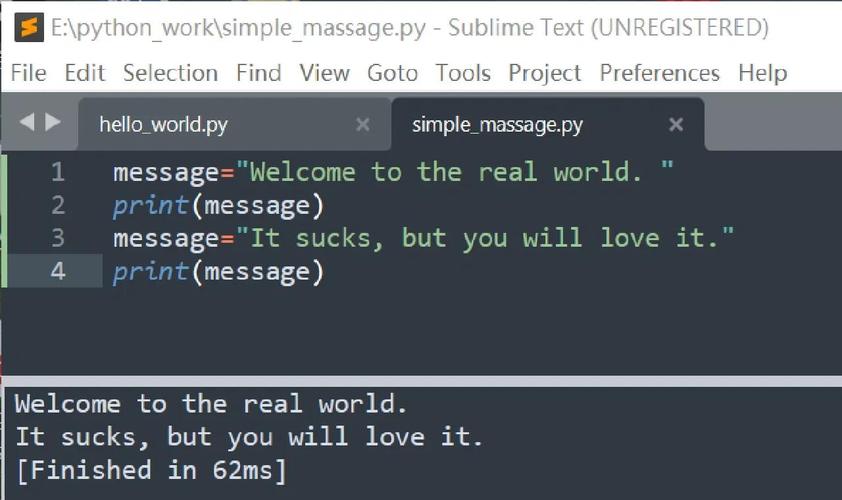
open()withwrite()andread()# Writing to a file with open("my_data.txt", "w") as f: f.write("Hello, world!\n") f.write("This is a second line.\n") # Reading from a file with open("my_data.txt", "r") as f: content = f.read() print(content) # Output: # Hello, world! # This is a second line. -
CSV (Comma-Separated Values): The standard for spreadsheet-like data.
import csv
# Writing to a CSV file
with open("users.csv", "w", newline="") as f:
    writer = csv.writer(f)
    writer.writerow(["name", "age", "city"])
    writer.writerow(["Alice", 30, "New York"])
    writer.writerow(["Bob", 25, "London"])
# Reading from a CSV file
with open("users.csv", "r") as f:
    reader = csv.reader(f)
    for row in reader:
        print(row)
        # Output:
        # ['name', 'age', 'city']
        # ['Alice', '30', 'New York']
        # ['Bob', '25', 'London']
B. JSON (JavaScript Object Notation)
The de-facto standard for web APIs and configuration files. It's lightweight, easy to read for humans and machines, and supports complex data structures (nested lists and dictionaries).
-
jsonmoduleimport json data = { "name": "Alice", "age": 30, "isStudent": False, "courses": ["History", "Math"], "address": { "street": "123 Main St", "city": "New York" } } # Writing to a JSON file (serialization) with open("data.json", "w") as f: json.dump(data, f, indent=4) # indent makes it readable # Reading from a JSON file (deserialization) with open("data.json", "r") as f: loaded_data = json.load(f) print(loaded_data["name"]) # Output: Alice
C. Pickle
A Python-specific module for serializing and de-serializing Python objects. It can save almost any Python object (lists, dicts, custom classes) to a binary file.
⚠️ Security Warning: Never unpickle data from an untrusted source, as it can execute arbitrary code.
import pickle
# A complex object
my_list = [1, 2, 3, {"a": "b", "c": [4, 5]}]
# Writing to a pickle file
with open("data.pkl", "wb") as f: # Note the 'wb' for write binary
    pickle.dump(my_list, f)
# Reading from a pickle file
with open("data.pkl", "rb") as f: # Note the 'rb' for read binary
    loaded_list = pickle.load(f)
    print(loaded_list)
    # Output: [1, 2, 3, {'a': 'b', 'c': [4, 5]}]
Binary File Formats (Efficient & Structured)
For large numerical datasets, text-based formats like CSV are slow. Binary formats are much more compact and faster to read/write.
| Format | Description | Best For | Python Example |
|---|---|---|---|
| HDF5 | Hierarchical format for storing large, complex numerical datasets. | Scientific computing, big data, simulations. | import h5pywith h5py.File('data.h5', 'w') as f:f.create_dataset('dset', data=np.arange(100)) |
| SQLite | A serverless, self-contained SQL database engine. | Embedded databases, mobile apps, desktop apps. | import sqlite3conn = sqlite3.connect('my_database.db')cursor = conn.cursor()cursor.execute("CREATE TABLE users (name TEXT, age INTEGER)") |
Pandas (.parquet, .feather) |
Parquet and Feather are binary formats optimized for speed and size. | Data analysis, data science, exchanging DataFrames. | import pandas as pddf = pd.DataFrame({'col1': [1, 2], 'col2': ['a', 'b']})df.to_parquet('data.parquet')df_loaded = pd.read_parquet('data.parquet') |
Database Systems (Scalable & Queryable)
When your data becomes too large or complex for files, or you need to perform complex queries, you need a database.
| Type | Description | Best For | Python Example |
|---|---|---|---|
| SQLite | (See above) | Lightweight, local, serverless apps. | Built-in sqlite3 module. |
| PostgreSQL / MySQL | Client-Server databases. Robust, scalable, ACID-compliant. | Web applications, large-scale systems, financial data. | psycopg2 (PostgreSQL), mysql-connector-python (MySQL). |
| MongoDB | NoSQL, document-oriented database. Stores JSON-like documents. | Flexible schemas, unstructured data, rapid development. | pymongo library. |
| Redis | NoSQL, in-memory key-value store. Extremely fast. | Caching, real-time analytics, queues. | redis library. |
Cloud Storage (For Web & Mobile Apps)
If your application needs to store data that is accessible from anywhere, you'll use a cloud storage provider.
| Provider | Description | Best For | Python Example |
|---|---|---|---|
| Amazon S3 | Simple Storage Service. Object storage for files, backups, media. | Storing user uploads, static website assets, backups. | boto3 library. |
| Google Cloud Storage | Similar to S3. Object storage for Google Cloud Platform. | Apps built on GCP, data lakes, ML model storage. | google-cloud-storage library. |
| Azure Blob Storage | Microsoft's object storage for Azure. | Apps built on Azure, hybrid cloud scenarios. | azure-storage-blob library. |
How to Choose: A Quick Guide
| Your Goal | Recommended Method | Why? |
|---|---|---|
| Store a simple list of settings | Text File or JSON | Human-readable, easy to edit. |
| Save the results of a script to share | CSV or JSON | Universal formats, easy to open in Excel or other languages. |
| Store complex Python objects temporarily | Pickle | Directly saves the object's state. |
| Analyze a large dataset (e.g., 1GB+) | Pandas with Parquet | Fast, memory-efficient, standard in data science. |
| Build a desktop or mobile app | SQLite | Serverless, no installation needed, good for local data. |
| Build a web application | PostgreSQL / MySQL | Scalable, robust, supports complex queries and transactions. |
| Store user-uploaded files (e.g., profile pics) | Cloud Storage (S3, GCS) | Scalable, durable, cheap, and offloads work from your server. |
Summary Table
| Category | Method | Key Characteristic | Use Case |
|---|---|---|---|
| In-Memory | Variables, Lists, Dictionaries | Fast, temporary | Data processing, algorithms |
| Text Files | Plain Text, CSV | Human-readable, simple | Logs, configs, simple data exchange |
| Structured Text | JSON | Web-friendly, complex data | APIs, configs, web data |
| Binary Files | Pickle | Python-specific, complex objects | Saving Python objects |
| Binary Files | HDF5, Parquet | Efficient, large numerical data | Scientific computing, data science |
| Local DB | SQLite | Serverless, SQL | Desktop/mobile apps, local data |
| Server DB | PostgreSQL, MongoDB | Scalable, powerful queries | Web applications, enterprise systems |
| Cloud Storage | S3, GCS | Scalable, accessible from anywhere | User uploads, backups, static assets |