Of course! Let's dive deep into the instanceof operator in Java. It's a fundamental tool for object-oriented programming, especially when dealing with inheritance and polymorphism.

What is instanceof?
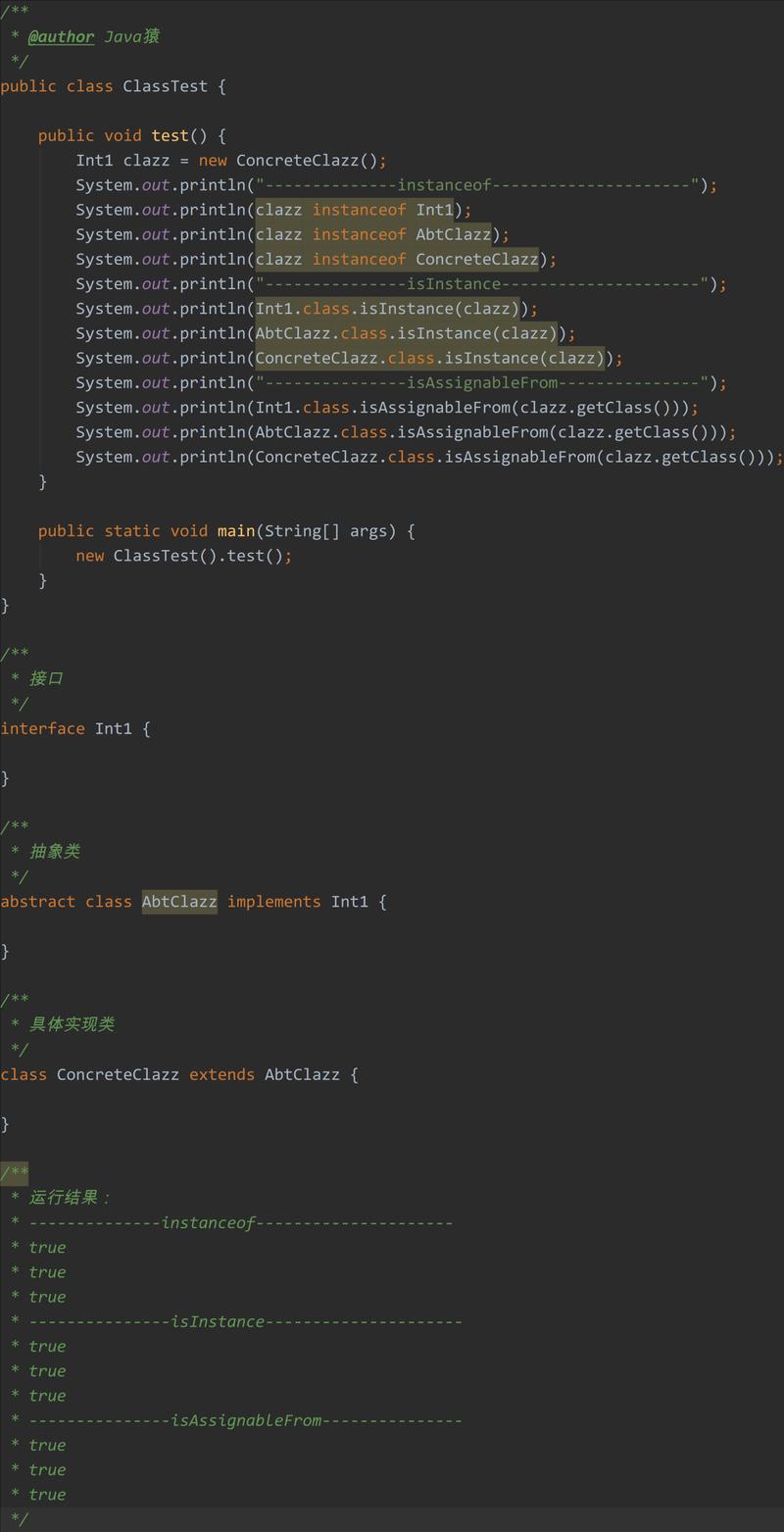
The instanceof operator is a binary operator used to check if an object is an instance of a particular class or interface at runtime. It returns a boolean value: true if the object is an instance of the specified type, and false otherwise.
Syntax:
object instanceof Type
object: The variable or reference you want to check. It can be of any reference type (a class or an interface).Type: The class or interface type you are checking against.
How It Works: The "Is-A" Relationship
instanceof checks if the object is an instance of Type or any of its subclasses. This is based on the "is-a" relationship in inheritance.
Key Rules:
instanceofwith a Class: It returnstrueif the object is an instance of that specific class or any of its direct/indirect subclasses.instanceofwith an Interface: It returnstrueif the object is an instance of a class that implements that interface (or one of its super-interfaces).nullCheck:instanceofalways returnsfalseif the object reference isnull. This is a crucial safety feature.- Compile-Time Check: The compiler will not allow you to use
instanceofto check against an unrelated type. For example, you can't check if aStringis an instance of anInteger.
Simple Code Example
Let's start with a basic inheritance hierarchy.
// Parent class
class Animal {
    void eat() {
        System.out.println("This animal eats food.");
    }
}
// Child class
class Dog extends Animal {
    void bark() {
        System.out.println("Woof!");
    }
}
// Another child class
class Cat extends Animal {
    void meow() {
        System.out.println("Meow!");
    }
}
public class InstanceOfExample {
    public static void main(String[] args) {
        // Create instances
        Animal myAnimal = new Animal();
        Animal myDog = new Dog();  // Polymorphism: Dog IS-A Animal
        Animal myCat = new Cat();  // Polymorphism: Cat IS-A Animal
        Animal nullAnimal = null;
        // --- instanceof checks ---
        // 1. Check if myDog is an instance of Dog
        if (myDog instanceof Dog) {
            System.out.println("myDog is an instance of Dog."); // This will print
        }
        // 2. Check if myDog is an instance of its parent class, Animal
        if (myDog instanceof Animal) {
            System.out.println("myDog is an instance of Animal."); // This will also print
        }
        // 3. Check if myAnimal is an instance of Dog
        if (myAnimal instanceof Dog) {
            System.out.println("myAnimal is an instance of Dog."); // This will NOT print
        }
        // 4. Check a null reference (always false)
        if (nullAnimal instanceof Dog) {
            System.out.println("nullAnimal is an instance of Dog."); // This will NOT print
        } else {
            System.out.println("nullAnimal is not an instance of Dog."); // This will print
        }
        // 5. Check if myCat is an instance of Dog (unrelated types)
        // The compiler would NOT allow this:
        // if (myCat instanceof Dog) { ... } // COMPILE ERROR: Incompatible conditional operand types Cat and Dog
    }
}
The Modern Way: instanceof with Pattern Matching (Java 16+)
This is a game-changing feature that simplifies code significantly. Before Java 16, you would often do this:
The "Old Way" (Casting and Checking)
You would first check with instanceof, then cast the object to the specific type to access its members.
// This is the common pre-Java 16 pattern
public void performAction(Animal animal) {
    if (animal instanceof Dog) {
        // You MUST cast to access Dog-specific methods
        Dog myDog = (Dog) animal;
        myDog.bark();
    } else if (animal instanceof Cat) {
        Cat myCat = (Cat) animal;
        myCat.meow();
    } else {
        animal.eat();
    }
}
The "New Way" (Pattern Matching for instanceof)
Since Java 16, you can combine the check and the cast into a single operation. The instanceof operator now declares a new variable of the target type if the check is successful.
// This is the modern, cleaner way (Java 16+)
public void performActionModern(Animal animal) {
    if (animal instanceof Dog myDog) { // Check AND cast in one line!
        myDog.bark(); // myDog is already a Dog, no cast needed!
    } else if (animal instanceof Cat myCat) {
        myCat.meow(); // myCat is already a Cat
    } else {
        animal.eat();
    }
}
Benefits of Pattern Matching:
- Concise: Reduces boilerplate code.
- Safer: Eliminates the possibility of a
ClassCastExceptionthat can happen with manual casting if you make a mistake. - Readable: The intent is clearer. The code says "if this is a Dog, let's call it
myDog."
Advanced Example: Using with Interfaces
instanceof works perfectly with interfaces.
interface Swimmer {
    void swim();
}
interface Flyer {
    void fly();
}
class Duck implements Swimmer, Flyer {
    @Override
    public void swim() {
        System.out.println("Duck is swimming.");
    }
    @Override
    public void fly() {
        System.out.println("Duck is flying.");
    }
}
class Fish implements Swimmer {
    @Override
    public void swim() {
        System.out.println("Fish is swimming.");
    }
}
public class InterfaceInstanceOf {
    public static void checkAbilities(Object obj) {
        if (obj instanceof Swimmer) {
            System.out.println("This object can swim.");
            // You can safely cast to Swimmer
            Swimmer swimmer = (Swimmer) obj;
            swimmer.swim();
        }
        if (obj instanceof Flyer) {
            System.out.println("This object can fly.");
        }
    }
    public static void main(String[] args) {
        checkAbilities(new Duck());
        // Output:
        // This object can swim.
        // Duck is swimming.
        // This object can fly.
        System.out.println("---");
        checkAbilities(new Fish());
        // Output:
        // This object can swim.
        // Fish is swimming.
    }
}
Best Practices and Common Pitfalls
-
Avoid
instanceofwhen Polymorphism is Better: If you find yourself writing a long chain ofif-else ifstatements based oninstanceof, it's often a "code smell." This suggests you might be violating the Open/Closed Principle. A better approach is to use polymorphism by defining a method in the base class (Animal) and overriding it in the subclasses (Dog,Cat).Bad (using
instanceof):void makeSound(Animal animal) { if (animal instanceof Dog) { /* ... */ } else if (animal instanceof Cat) { /* ... */ } // ... and so on for every subclass }Good (using Polymorphism):
// In Animal class void makeSound() { System.out.println("Some generic sound."); } // In Dog class @Override void makeSound() { System.out.println("Woof!"); } // In Cat class @Override void makeSound() { System.out.println("Meow!"); } // Your calling code is now simple and extensible void letAnimalSpeak(Animal animal) { animal.makeSound(); // The correct method is called automatically } -
Always Check for
null: Whileinstanceofhandlesnullgracefully (returnsfalse), it's good practice to be aware of it. If your method can receivenull, you might want to handle it explicitly. -
Use Pattern Matching: If you are using Java 16 or newer, always prefer the pattern matching syntax. It is safer, cleaner, and the future of Java.
Summary
| Feature | Description |
|---|---|
| What it is | A runtime operator to check if an object is an instance of a class or interface. |
| Syntax | object instanceof Type |
| Return Value | boolean (true or false) |
null Handling |
Always returns false. |
| Inheritance Rule | Returns true for the object's type, its parent types, and any interfaces it implements. |
| Modern Feature (J16+) | Pattern Matching: Combines the check and cast into one step, e.g., if (obj instanceof Dog d) { ... } |
| Main Use Case | Safe downcasting before accessing subclass-specific members. |
| Pitfall to Avoid | Overusing instanceof in long if-else chains when polymorphism would be a better design choice. |