Of course! Let's break down Python's @classmethod in detail, from the basic concept to practical examples.
What is a @classmethod?
In Python, a @classmethod is a decorator that declares a method in the class to be a class method. This means the method operates on the class itself, rather than on an instance of the class.
The key difference from a regular instance method is that:
- An instance method receives the instance (
self) as its first argument. - A class method receives the class (
cls) as its first argument.
The Core Concept: self vs. cls
Let's visualize the difference:
class MyClass:
    def instance_method(self):
        print(f"Called an instance method on object: {self}")
    @classmethod
    def class_method(cls):
        print(f"Called a class method on class: {cls}")
# --- Usage ---
# Create an instance
obj = MyClass()
# Calling an instance method
obj.instance_method()
# Output: Called an instance method on object: <__main__.MyClass object at 0x...>
# Calling a class method
# You can call it on the class itself
MyClass.class_method()
# Output: Called a class method on class: <class '__main__.MyClass'>
# Or you can call it on an instance (it's the same thing)
obj.class_method()
# Output: Called a class method on class: <class '__main__.MyClass'>
self: Represents the specific instance of the class. It allows you to access and modify instance-specific data (attributes) and behavior.cls: Represents the class itself. It allows you to access and modify class-level data and behavior.
When to Use @classmethod?
Use @classmethod when your method needs to:
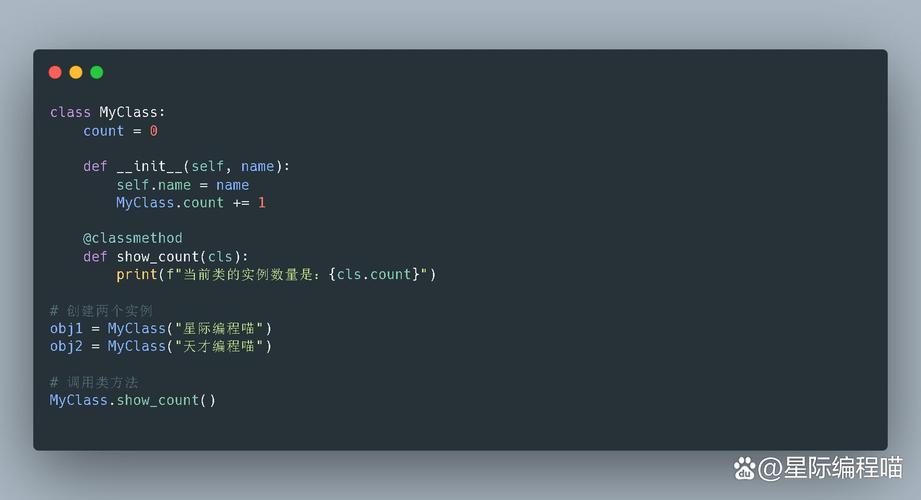
- Access or modify class-level attributes: When the logic involves data that is shared across all instances of the class.
- Provide alternative constructors: This is the most common and powerful use case. A class method can create and return an instance of the class, but with different initialization logic than the standard
__init__. - Group utility functions related to the class: When you have a function that conceptually belongs to the class but doesn't need to act on any specific instance.
Practical Examples
Example 1: Alternative Constructor
This is the classic example. Imagine you have a Person class that is initialized with a name and age. But what if you want to create a Person instance from a string like "John Doe, 30"? You can't put that logic in __init__ because __init__ expects the data already parsed.
A @classmethod is perfect for this.
class Person:
    def __init__(self, name, age):
        print("Running __init__...")
        self.name = name
        self.age = age
    @classmethod
    def from_string(cls, person_str):
        """
        An alternative constructor to create a Person from a string.
        """
        print("Running from_string class method...")
        name, age = person_str.split(', ')
        # We use cls() to create a new instance of the class
        return cls(name, age)
# --- Usage ---
# Standard way
p1 = Person("Alice", 25)
print(f"Name: {p1.name}, Age: {p1.age}\n")
# Output:
# Running __init__...
# Name: Alice, Age: 25
# Using the alternative constructor
person_data = "Bob, 40"
p2 = Person.from_string(person_data)
print(f"Name: {p2.name}, Age: {p2.age}")
# Output:
# Running from_string class method...
# Running __init__...
# Name: Bob, Age: 40
Notice how from_string uses cls(name, age) to create the instance. This is the key pattern for alternative constructors.
Example 2: Managing Class-Level State
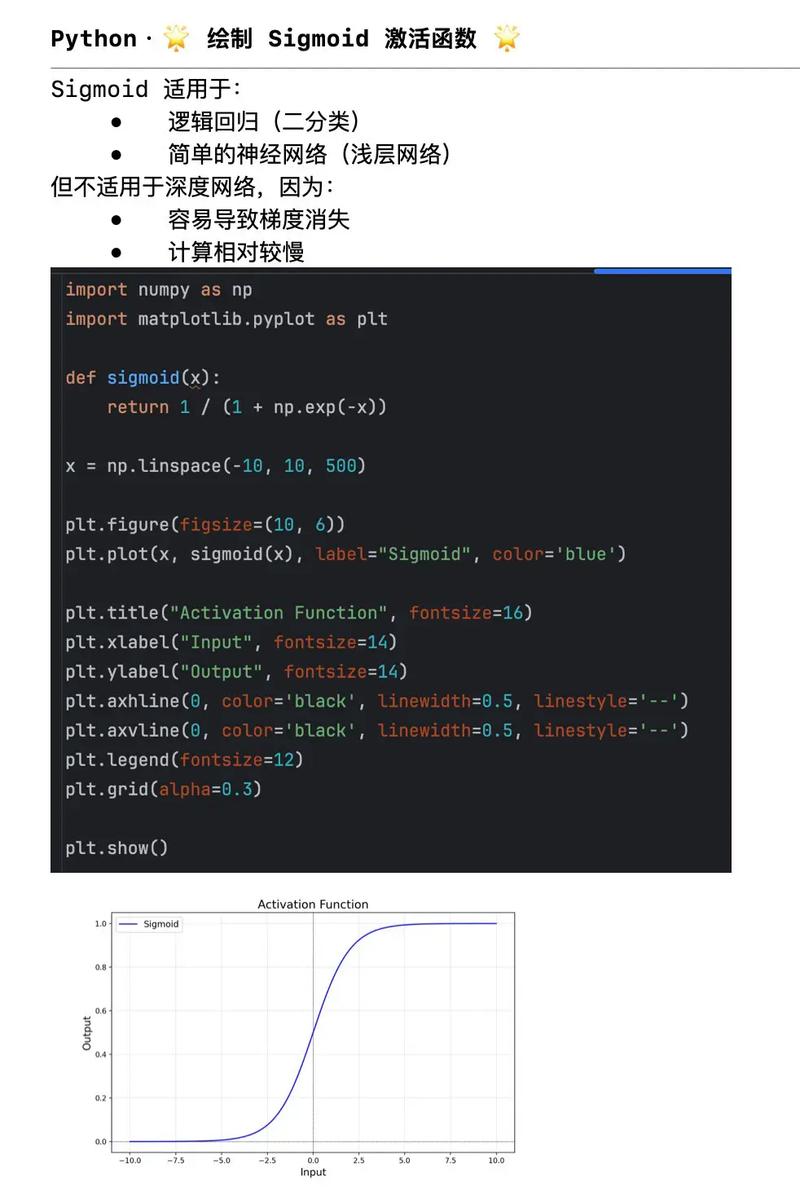
Let's say you want to keep track of how many instances of a class have been created.
class BankAccount:
    # This is a CLASS attribute, shared by all instances
    interest_rate = 0.05
    total_accounts = 0
    def __init__(self, owner, balance):
        self.owner = owner
        self.balance = balance
        # We use the class to modify the class attribute
        BankAccount.total_accounts += 1
    @classmethod
    def set_interest_rate(cls, new_rate):
        """
        Modifies the class-level interest rate for all accounts.
        """
        cls.interest_rate = new_rate
        print(f"Interest rate updated to {new_rate * 100}% for all accounts.")
    def apply_interest(self):
        """Applies the class interest rate to this account's balance."""
        self.balance += self.balance * BankAccount.interest_rate
        print(f"{self.owner}'s new balance: ${self.balance:.2f}")
# --- Usage ---
# Create some accounts
acc1 = BankAccount("Charlie", 1000)
acc2 = BankAccount("Diana", 2000)
print(f"Total accounts created: {BankAccount.total_accounts}\n")
# Output: Total accounts created: 2
# All accounts share the same interest rate initially
acc1.apply_interest()
# Output: Charlie's new balance: $1050.00
# Now, let's change the interest rate for ALL accounts using the class method
BankAccount.set_interest_rate(0.07)
# Output: Interest rate updated to 7.0% for all accounts.
# The new rate applies to all existing and future accounts
acc1.apply_interest()
# Output: Charlie's new balance: $1123.50
acc2.apply_interest()
# Output: Diana's new balance: $2140.00
Here, set_interest_rate modifies cls.interest_rate, which is the same as modifying BankAccount.interest_rate. This change is reflected for all instances.
Comparison: @staticmethod vs. @classmethod
It's common to confuse @classmethod with @staticmethod. Here's a quick guide:
| Feature | @classmethod |
@staticmethod |
|---|---|---|
| First Argument | Receives the class (cls) as the first argument. |
Receives no special first argument. |
| Purpose | Operates on the class. Can modify class state. | A regular function that lives inside the class namespace. |
| Access | Can access and modify class attributes via cls. |
Cannot access class (cls) or instance (self) attributes directly. |
| Use Case | Alternative constructors, class-level factory methods. | Utility functions that are thematically related to the class but don't depend on the class or its instances. |
Example of @staticmethod
Let's add a utility function to our BankAccount class that validates a currency amount. This function doesn't need to know about any specific account or the BankAccount class itself; it's just a helper.
class BankAccount:
    # ... (previous code) ...
    @staticmethod
    def is_valid_amount(amount):
        """
        A utility function to check if an amount is positive.
        It doesn't need 'self' or 'cls'.
        """
        if isinstance(amount, (int, float)) and amount > 0:
            return True
        return False
# --- Usage ---
print(f"Is 100 a valid amount? {BankAccount.is_valid_amount(100)}")
# Output: Is 100 a valid amount? True
print(f"Is -50 a valid amount? {BankAccount.is_valid_amount(-50)}")
# Output: Is -50 a valid amount? False
print(f"Is 'hello' a valid amount? {BankAccount.is_valid_amount('hello')}")
# Output: Is 'hello' a valid amount? False
Summary Table
| Method Type | Decorator | First Argument | Purpose |
|---|---|---|---|
| Instance Method | (none) | self |
The default. Operates on an instance. Used for object-specific behavior and data. |
| Class Method | @classmethod |
cls |
Operates on the class itself. Used for class-level data, alternative constructors, and factory methods. |
| Static Method | @staticmethod |
(none) | A regular function inside the class. Used for utility functions that don't need access to the class or instance. |