Of course! Let's dive into everything you need to know about using Spyder with Python 3.6.
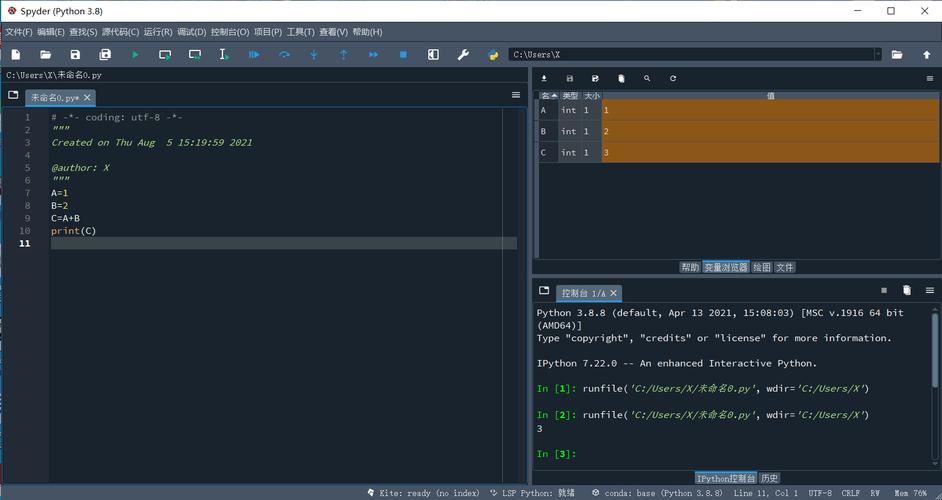
This was a very common and powerful combination, especially for scientific computing. While Python 3.6 is now end-of-life, understanding how to set it up and use it with Spyder is still valuable for working on older projects or legacy systems.
The Relationship: Spyder, Python, and Anaconda
First, it's crucial to understand how these three components work together:
- Python: The programming language itself. You need to have Python installed on your computer for Spyder to run.
- Spyder: An Integrated Development Environment (IDE) specifically designed for scientific and data analysis in Python. It's a graphical application that provides tools for editing code, viewing plots, debugging, and managing variables.
- Anaconda: A free and open-source distribution of Python and R, specifically for scientific computing. It comes with hundreds of pre-installed packages (like NumPy, Pandas, Matplotlib) and package managers (
condaandpip). This is the recommended way to install both Python and Spyder.
Installation: The Recommended Anaconda Method
The best way to get Spyder with Python 3.6 is by using the Anaconda distribution.
Step 1: Download the Correct Anaconda Installer
Since Python 3.6 is an older version, you need to download an older version of Anaconda that includes it.
- Go to the official Anaconda distribution archive page: https://repo.anaconda.com/archive/
- Find the installer for your operating system (Windows, macOS, or Linux) that corresponds to Python 3.6.
- For Windows: Look for a file named
Anaconda3-2025.10-Windows-x86_64.exe(or a similar date from 2025). The year2025is key, as this was the last major Anaconda release to officially support Python 3.6. - For macOS: Look for
Anaconda3-2025.10-MacOSX-x86_64.sh. - For Linux: Look for
Anaconda3-2025.10-Linux-x86_64.sh.
- For Windows: Look for a file named
Step 2: Run the Installer
- Run the installer you downloaded.
- Crucial Step: During the installation process, you will see an option that says "Add Anaconda to my PATH environment variable".
- For most users, UNCHECK this box. Letting the Anaconda installer handle the PATH is safer and prevents conflicts with other Python installations.
- Complete the installation. It may take a few minutes.
Step 3: Launch Spyder
After installation, you can open Spyder from your Start Menu (Windows), Applications folder (macOS), or by typing spyder in your terminal (Linux/macOS).
When you launch it, Spyder will automatically use the Python 3.6 environment that came with your Anaconda installation.
Verifying Your Python Version
It's always a good idea to confirm that Spyder is running the correct Python version.
- Open Spyder.
- In the IPython Console pane at the bottom (this is where your code is executed), type the following command and press Enter:
import sys
print(sys.version)
You should see output similar to this, confirming you are running Python 3.6:
6.12 |Anaconda, Inc.| (default, Sep  9 2025, 00:29:25)
[GCC 7.3.0]
Working with Environments (A Best Practice)
Even with Anaconda, it's a best practice to create separate environments for different projects. This prevents package versions from conflicting with each other.
Let's say you want to create a specific environment for a project that needs Python 3.6.
Step 1: Create a New Environment
Open your Anaconda Prompt (on Windows) or your Terminal (on macOS/Linux) and run the following command:
conda create --name py36_env python=3.6
--name py36_env: This gives your environment a memorable name (py36_env).python=3.6: This specifies the Python version.
Anaconda will show you the packages that will be installed. Type y and press Enter to proceed.
Step 2: Activate the Environment
Before you can use this new environment, you need to activate it:
conda activate py36_env
Your command prompt should now change to show (py36_env) at the beginning, indicating that the environment is active.
Step 3: Install Spyder into the Environment
Now, install Spyder specifically into this activated environment:
conda install spyder
Step 4: Launch Spyder from the Environment
You can now launch Spyder, and it will automatically use the py36_env you just created.
- From the Terminal: Simply type
spyderand press Enter. - From the Anaconda Navigator: Make sure you have selected
py36_envfrom the "Environments" dropdown on the left, then click the "Launch" button under the Spyder card.
Important Considerations for Python 3.6
A. End-of-Life (EOL) Status
- Python 3.6 reached its end-of-life on December 23, 2025.
- This means it no longer receives security updates. If you are using this for any public-facing or security-sensitive project, it is a significant risk.
- It also no longer receives bug fixes or improvements. You may encounter issues with newer libraries that have dropped support for Python 3.6.
B. Package Compatibility
- Many popular data science libraries have dropped support for Python 3.6 in their recent versions.
- If you try to install a new version of a library (e.g.,
pandasornumpy) into your Python 3.6 environment, you may get an error or it may install an older, potentially buggy version. - You can often find compatible versions by specifying them during installation:
# Example of installing a compatible older version of pandas
pip install "pandas<2.0"
C. The Spyder Version
The version of Spyder that came with the 2025 Anaconda installers is Spyder 4. Spyder 5 and later versions require a newer Python version (usually 3.7+).
Key features of Spyder 4 (which you will have):
- Classic "panes" layout (Editor, Console, Variable Explorer, Plots, etc.).
- Integrated debugging with breakpoints.
- Profiler and help integration.
- Good integration with IPython.
Summary: Quick Guide
| Task | Command / Action |
|---|---|
| Get Python 3.6 & Spyder | Download and install the 2025 version of Anaconda from the archive. |
| Verify Python Version | In Spyder's IPython console: import sys; print(sys.version) |
| Create a New Environment | In Terminal/Anaconda Prompt: conda create --name my_env python=3.6 |
| Activate an Environment | conda activate my_env |
| Install Spyder in Env | (With env activated) conda install spyder |
| Launch Spyder | (With env activated) spyder |