Of course. Comparing a language to Java is a common and useful exercise because Java has been a dominant force for decades, setting many standards for enterprise, backend, and Android development.

However, you haven't specified which language you want to compare to Java. I'll provide a comparison with several of the most popular and relevant languages, each highlighting their key differences from Java.
First, let's establish a quick profile of Java itself.
The Baseline: What is Java?
- Paradigm: Primarily object-oriented (OOP), with support for functional programming features added in recent versions (Java 8+).
- Platform: Runs on the Java Virtual Machine (JVM). This is its greatest strength, enabling "Write Once, Run Anywhere" (WORA).
- Typing: Statically typed and strongly typed. Errors are caught at compile-time, not runtime.
- Performance: Highly performant, especially for long-running server applications. The JVM's Just-In-Time (JIT) compiler optimizes code over time.
- Syntax: Verbose and explicit. This can be more readable for beginners but often requires more boilerplate code.
- Ecosystem: Massive and mature. Huge libraries (Spring, Hibernate), vast community, and extensive corporate support.
- Concurrency: Built-in, robust threading model, though it can be complex to get right.
Comparison 1: Python
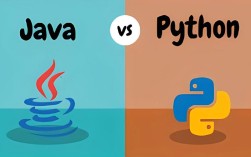
Python is often seen as Java's direct opposite in terms of philosophy.
| Feature | Java | Python |
|---|---|---|
| Syntax & Readability | Verbose, explicit. Requires type declarations, semicolons, and curly braces. | Concise, clean. Uses significant whitespace (indentation) instead of braces. Less boilerplate. |
| Typing | Statically Typed. String name = "Alice"; |
Dynamically Typed. name = "Alice" (type is inferred at runtime). |
| Performance | Generally Faster. Compiled to bytecode and JIT-optimized. Excellent for CPU-intensive tasks. | Generally Slower. Interpreted line-by-line. Slower for CPU-intensive tasks, but often fast enough for I/O-bound work. |
| Ecosystem & Use Cases | Enterprise backend, big data (Hadoop, Spark), Android development, high-frequency trading. | Data science, machine learning, AI, web development (Django, Flask), scripting, automation. |
| Concurrency | Thread-based, with robust but complex primitives (synchronized, volatile). |
GIL (Global Interpreter Limit) makes true multi-threading for CPU tasks difficult. Favors asyncio for concurrency. |
| Learning Curve | Steeper. Concepts like OOP, the JVM, and compilation are more complex for beginners. | Gentle. Easy to learn and get started quickly. Great for beginners. |
When to choose Python over Java:
- Rapid prototyping and development speed.
- Data analysis, machine learning, or scientific computing.
- Scripting and automation tasks.
- When development team productivity is the top priority.
When to choose Java over Python:
- Building large, long-running, and scalable backend systems.
- Applications where performance and throughput are critical.
- Android app development.
- Strong type safety is a non-negotiable requirement.
Comparison 2: C
C# is Java's closest "cousin." They are syntactically very similar but have evolved on different platforms.
| Feature | Java | C# |
|---|---|---|
| Platform | JVM. Runs anywhere the JVM is installed (WORA). | .NET (now cross-platform). Traditionally Windows-only, but .NET 5+ is cross-platform. |
| Syntax | Extremely similar. If you know Java, C# is very easy to pick up. | Extremely similar. Minor differences (e.g., properties with { get; set; }, using for disposal). |
| Ecosystem & Use Cases | Cross-platform enterprise, Android, big data. | Windows desktop apps, game development (Unity), enterprise (especially on Windows/Azure), web (ASP.NET). |
| Language Features | More conservative. New features are added slowly and cautiously. | More aggressive. Often adopts modern features first (e.g., async/await, pattern matching, records). |
| Tooling | Excellent Eclipse, IntelliJ IDEA. | Excellent Visual Studio, which is often considered the best IDE in the industry. |
| Ownership | Open-source (OpenJDK), but historically controlled by Oracle. | Open-source ( .NET Foundation), but historically controlled by Microsoft. |
When to choose C# over Java:
- Building Windows desktop applications (WPF, WinForms).
- Game development with Unity.
- You are deeply integrated into the Microsoft/Azure ecosystem.
- You prefer a more feature-rich language and the best-in-class Visual Studio IDE.
When to choose Java over C#:
- You need maximum platform portability (especially embedded systems or non-Windows servers).
- You are building Android apps.
- You prefer the stability and maturity of the Java ecosystem and its vast open-source libraries.
Comparison 3: Go (Golang)
Go was created by Google to address common criticisms of languages like Java and C++, particularly around concurrency and compilation speed.
| Feature | Java | Go |
|---|---|---|
| Syntax | Verbose, object-oriented. | Minimalist, clean, and simple. No classes or inheritance (uses structs and interfaces). |
| Typing | Statically typed. | Statically typed, but with a simpler type system (no generics until recently). |
| Concurrency | Complex thread-based model. | Superior. Built-in goroutines (lightweight threads) and channels for easy and safe concurrency. |
| Performance | Fast, but startup can be slow. | Extremely fast compilation. Excellent runtime performance, especially for concurrent applications. |
| Ecosystem & Use Cases | Monolithic enterprise apps. | Microservices, cloud-native applications, network services, command-line tools, DevOps. |
| Error Handling | Uses exceptions. | Explicit error checking with a multi-value return (result, err := ...). No exceptions. |
| Garbage Collection | Advanced generational GC. | Simple, non-generational GC. Can cause "stop-the-world" pauses, which is a trade-off for simplicity. |
When to choose Go over Java:
- Building microservices or networked services.
- When you need to compile and deploy code extremely quickly.
- When simple, predictable concurrency is a top priority.
- Creating high-performance command-line tools.
When to choose Java over Go:
- Building large, complex, object-oriented domain models.
- When you need a mature, battle-tested framework like Spring for enterprise applications.
- When advanced generics are a requirement.
- When very low and consistent GC pause times are critical.
Comparison 4: Kotlin
Kotlin is a modern language that is 100% interoperable with Java and is the official language for Android development.
| Feature | Java | Kotlin |
|---|---|---|
| Relationship | The "old guard." | A modern, JVM-based language designed to improve upon Java. |
| Syntax | Verbose, boilerplate-heavy. | Concise and expressive. Reduces boilerplate by an estimated 40%. |
| Null Safety | No compile-time null safety. NullPointerException is a runtime error. |
Built-in null safety. The type system distinguishes between nullable (String?) and non-nullable (String) types. |
| Features | OOP-first. | Pragmatic blend. Supports OOP but has excellent first-class support for functional programming (data classes, lambdas, extension functions). |
| Tooling | Excellent. | Excellent. Fully supported in IntelliJ IDEA and Android Studio. |
| Adoption | Massive, legacy codebase. | Rapidly growing, especially in Android and new Spring Boot projects. |
When to choose Kotlin over Java:
- Android development. It's the official and recommended language.
- Any new project on the JVM where developer productivity and code safety are key.
- When you want a more modern, concise, and safer language without leaving the JVM ecosystem.
When to choose Java over Kotlin:
- Maintaining a large legacy Java codebase.
- When you need to support very old Java versions (Kotlin requires 1.6+).
- In environments where the team has no interest in adopting a new language.
Summary Table
| Language | Key Differentiator from Java | Best For |
|---|---|---|
| Python | Dynamic typing, concise syntax, data science focus. | Rapid development, data science, scripting. |
| C# | Windows/.NET integration, modern language features. | Windows desktop, game dev, Microsoft ecosystem. |
| Go | Simplicity, lightning-fast compilation, superior concurrency. | Microservices, cloud, network services, CLI tools. |
| Kotlin | Concise syntax, null safety, 100% Java interoperability. | Modern Android development, new JVM projects. |