Of course! Let's break down the classic Service-DAO architecture pattern in Java. This is a foundational design pattern for building robust, maintainable, and testable applications, especially in enterprise environments.
The Big Picture: Why Use This Pattern?
Imagine you're building an application that manages users. You need to:
- Save a new user to the database.
- Find a user by their ID.
- Update a user's email address.
- Delete a user.
Without a pattern, you might put all the database logic directly in your code that handles web requests (like a Spring MVC controller). This is a bad idea because:
- Tight Coupling: Your web layer becomes tightly linked to your database. If you decide to switch from a MySQL database to a MongoDB database, you have to change your web layer.
- Hard to Test: Testing the web layer requires a real database connection. This is slow and complex.
- Code Reuse: If another part of your application (like a scheduled job) also needs to find a user, you have to duplicate the database logic.
- Violation of Single Responsibility Principle: A class should do one thing well. A controller should handle HTTP requests, not manage database connections and SQL queries.
The Service-DAO pattern solves these problems by creating a clear separation of concerns.
The Three Layers
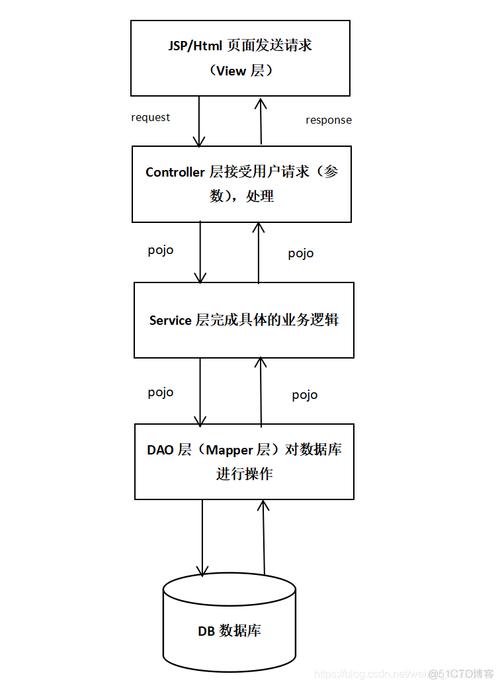
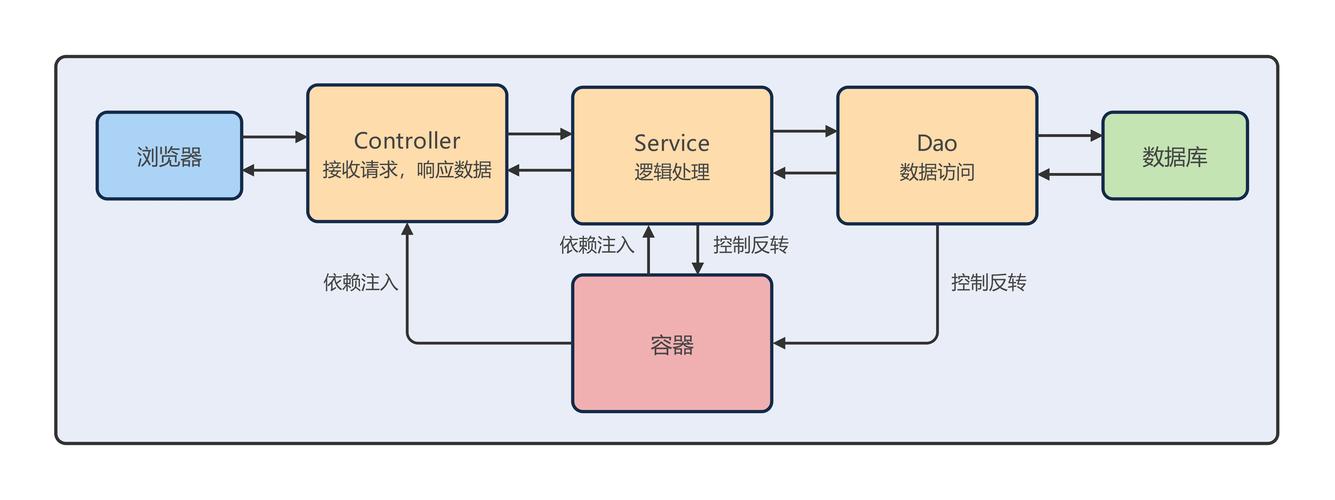
Let's visualize the flow of a request through the three main layers:
Client (e.g., Web Browser) -> Controller -> Service -> DAO -> Database
Here's what each layer does:
Controller Layer (The "Front Desk")
- Responsibility: Handles incoming HTTP requests from a client (like a web browser or another API).
- Tasks:
- Parse request parameters (e.g., from a URL or JSON body).
- Call the appropriate Service method.
- Receive the result from the Service.
- Format the result into an HTTP response (e.g., JSON, XML, or an HTTP status code like 200 OK or 404 Not Found).
- Key Point: The Controller knows nothing about the database. It only knows about the Service layer.
Service Layer (The "Business Logic")
- Responsibility: Contains the core business logic of the application. This is the "brain" of your application.
- Tasks:
- Orchestrate operations by calling one or more DAOs.
- Implement business rules and validations.
- Manage transactions (e.g., ensure that if two database operations must succeed, they either both succeed or both fail).
- Perform calculations or data transformations.
- Example: A
UserServicemight have aregisterUsermethod that first checks if the username is already taken (using aUserDAO), then saves the new user (usingUserDAOagain), and then sends a welcome email. The controller just says "register this user," and the service handles the "how."
DAO Layer (The "Data Accessor")
- Responsibility: Provides an abstract interface to the database. Its only job is to perform CRUD (Create, Read, Update, Delete) operations.
- Tasks:
- Execute SQL queries or use an ORM (like Hibernate/JPA) to interact with the database.
- Map database results (like
ResultSetobjects) to Java objects (likeUserentities). - Handle low-level database exceptions.
- Key Point: The DAO is completely ignorant of the business logic. It doesn't know why you're saving a user, only how to save it.
Code Example: A User Management System
Let's see this in action with a simple Spring Boot application.
The Model (Entity)
This is the plain Java object that represents our data.
User.java
package com.example.demo.model;
// JPA annotation to mark this as a database entity
import jakarta.persistence.Entity;
import jakarta.persistence.GeneratedValue;
import jakarta.persistence.GenerationType;
import jakarta.persistence.Id;
@Entity // Marks this class as a JPA entity (a table in the database)
public class User {
    @Id // Marks this field as the primary key
    @GeneratedValue(strategy = GenerationType.IDENTITY) // Auto-incrementing ID
    private Long id;
    private String username;
    private String email;
    // Constructors, Getters, and Setters (omitted for brevity)
    // It's good practice to have a no-arg constructor for JPA
}
The DAO Layer
First, the interface that defines the contract.
UserDao.java
package com.example.demo.dao;
import com.example.demo.model.User;
import java.util.Optional;
// This interface defines the data access operations for the User entity.
public interface UserDao {
    // Find a user by their ID
    Optional<User> findById(Long id);
    // Find a user by their username
    Optional<User> findByUsername(String username);
    // Save a new user or update an existing one
    void save(User user);
    // Delete a user by their ID
    void deleteById(Long id);
}
Now, the implementation. In a real Spring app, this would likely use Spring Data JPA, which automatically generates the implementation for you. But to show the pattern, here's a manual implementation.
UserDaoImpl.java (This is often simplified with Spring Data)
package com.example.demo.dao;
import com.example.demo.model.User;
import org.springframework.stereotype.Repository;
import jakarta.persistence.EntityManager;
import jakarta.persistence.PersistenceContext;
import java.util.Optional;
import java.util.List;
@Repository // Stereotype annotation for a DAO component
public class UserDaoImpl implements UserDao {
    @PersistenceContext // Injects the JPA EntityManager
    private EntityManager entityManager;
    @Override
    public Optional<User> findById(Long id) {
        User user = entityManager.find(User.class, id);
        return Optional.ofNullable(user);
    }
    @Override
    public Optional<User> findByUsername(String username) {
        // In a real app, you'd use a JPQL query or a CriteriaQuery
        List<User> users = entityManager.createQuery(
            "SELECT u FROM User u WHERE u.username = :username", User.class)
            .setParameter("username", username)
            .getResultList();
        return users.isEmpty() ? Optional.empty() : Optional.of(users.get(0));
    }
    @Override
    public void save(User user) {
        if (user.getId() == null) {
            entityManager.persist(user); // New entity
        } else {
            entityManager.merge(user); // Existing entity
        }
    }
    @Override
    public void deleteById(Long id) {
        User user = entityManager.find(User.class, id);
        if (user != null) {
            entityManager.remove(user);
        }
    }
}
The Service Layer
First, the interface.
UserService.java
package com.example.demo.service;
import com.example.demo.model.User;
public interface UserService {
    User createUser(String username, String email);
    Optional<User> getUserById(Long id);
    // ... other methods like updateUser, deleteUser
}
Now, the implementation, which contains the business logic.
UserServiceImpl.java
package com.example.demo.service;
import com.example.demo.dao.UserDao;
import com.example.demo.model.User;
import org.springframework.beans.factory.annotation.Autowired;
import org.springframework.stereotype.Service;
import org.springframework.transaction.annotation.Transactional;
import java.util.Optional;
@Service // Stereotype annotation for a Service component
public class UserServiceImpl implements UserService {
    // The service depends on the DAO to interact with the database
    private final UserDao userDao;
    // Use constructor injection (best practice)
    @Autowired
    public UserServiceImpl(UserDao userDao) {
        this.userDao = userDao;
    }
    @Override
    @Transactional // This ensures the method runs in a transaction
    public User createUser(String username, String email) {
        // Business Rule: Username must not be empty
        if (username == null || username.trim().isEmpty()) {
            throw new IllegalArgumentException("Username cannot be empty.");
        }
        // Business Rule: Username must be unique
        if (userDao.findByUsername(username).isPresent()) {
            throw new IllegalStateException("Username '" + username + "' is already taken.");
        }
        // Create the new user object
        User newUser = new User();
        newUser.setUsername(username);
        newUser.setEmail(email);
        // Delegate the saving to the DAO layer
        userDao.save(newUser);
        return newUser;
    }
    @Override
    public Optional<User> getUserById(Long id) {
        // Simply delegate to the DAO. No business logic needed here.
        return userDao.findById(id);
    }
}
The Controller Layer
This exposes our service functionality via a REST API.
UserController.java
package com.example.demo.controller;
import com.example.demo.model.User;
import com.example.demo.service.UserService;
import org.springframework.beans.factory.annotation.Autowired;
import org.springframework.http.HttpStatus;
import org.springframework.http.ResponseEntity;
import org.springframework.web.bind.annotation.*;
@RestController // Combines @Controller and @ResponseBody
@RequestMapping("/api/users") // Base path for all endpoints in this controller
public class UserController {
    private final UserService userService;
    @Autowired
    public UserController(UserService userService) {
        this.userService = userService;
    }
    // Endpoint to create a new user
    @PostMapping
    public ResponseEntity<User> createUser(@RequestBody User user) {
        try {
            // The controller just calls the service and returns the result
            User createdUser = userService.createUser(user.getUsername(), user.getEmail());
            return new ResponseEntity<>(createdUser, HttpStatus.CREATED);
        } catch (IllegalArgumentException | IllegalStateException e) {
            // Handle business logic errors (e.g., duplicate username)
            return new ResponseEntity<>(null, HttpStatus.CONFLICT); // 409 Conflict
        } catch (Exception e) {
            // Handle other unexpected errors
            return new ResponseEntity<>(null, HttpStatus.INTERNAL_SERVER_ERROR);
        }
    }
    // Endpoint to get a user by ID
    @GetMapping("/{id}")
    public ResponseEntity<User> getUserById(@PathVariable Long id) {
        return userService.getUserById(id)
                .map(user -> new ResponseEntity<>(user, HttpStatus.OK)) // 200 OK
                .orElse(new ResponseEntity<>(HttpStatus.NOT_FOUND)); // 404 Not Found
    }
}
Summary of Benefits
| Layer | Responsibility | Benefits |
|---|---|---|
| Controller | HTTP Request/Response Handling | - Decouples presentation logic from business logic. - Easy to test without a web server. |
| Service | Business Logic & Orchestration | - Single Responsibility: Focuses on business rules. - Testability: Business logic can be unit-tested by mocking DAOs. - Reusability: Business logic can be used by different clients (web, mobile, batch jobs). |
| DAO | Data Persistence | - Abstraction: The rest of the app is unaware of the database type (SQL, NoSQL, file system). - Testability: You can test the Service layer with a mock DAO that doesn't need a real DB. - Maintainability: Switching databases or data sources becomes much easier. |
Modern Variations & Frameworks
- Spring Data JPA / Spring Data MongoDB: These frameworks drastically simplify the DAO layer. You typically only need to define an interface (like
public interface UserRepository extends JpaRepository<User, Long> {}), and Spring provides the implementation automatically. The pattern still holds, but the DAO implementation is handled by the framework. - Repository Pattern: This is often used as a synonym for DAO, but it can be a more generic data access layer that might not map 1-to-1 with a database table (e.g., it could query multiple tables).
- DTO (Data Transfer Object): A common addition to this pattern is to use DTOs to pass data between layers. A
Userentity might have apasswordfield, but you wouldn't want to send that to a client. AUserDtowould contain onlyid,username, andemail. The Service layer would convert theUserentity to aUserDtobefore returning it to the Controller. This adds another layer of security and flexibility.