Of course! Let's dive deep into ThreadLocal in Java. It's a powerful but often misunderstood tool. We'll cover what it is, why it's needed, how it works, its pitfalls, and best practices.
What is ThreadLocal?
ThreadLocal is a class in Java that provides thread-local variables. These are variables whose value is specific to the current thread and is not shared between threads.
In simpler terms: Each thread that accesses a ThreadLocal variable gets its own, independently initialized copy of the variable.
Think of it as a special box that each thread has its own private key to. What one thread puts in its box is invisible to all other threads.
The Problem ThreadLocal Solves
Imagine you need to pass context information (like a user ID, a transaction ID, or a security token) down through a deep call stack in a multi-threaded application. Without ThreadLocal, you would have to:
- Pass the context as an explicit parameter to every single method in the call stack.
- Or, use some global, shared state, which introduces concurrency issues like race conditions.
Example: The "Parameter Passing Nightmare"
Let's say you have a method that needs the current user's ID.
// A deep call stack
public class UserService {
    public void processOrder() {
        String userId = getCurrentUserId(); // <-- Where do we get this from?
        OrderService orderService = new OrderService();
        orderService.createOrder(userId); // Pass it down
    }
}
class OrderService {
    public void createOrder(String userId) {
        // ... some logic ...
        PaymentService paymentService = new PaymentService();
        paymentService.processPayment(userId); // Pass it down again
    }
}
class PaymentService {
    public void processPayment(String userId) {
        // ... more logic ...
        // We need userId here too!
    }
}
As you can see, the userId parameter has to be passed down through every layer of the application, even if intermediate methods don't use it directly. This is tedious, error-prone, and clutters your code.
ThreadLocal to the Rescue:
With ThreadLocal, you can store the userId in a thread-local variable. Any part of the code running in the same thread can access this variable without it being passed around.
// A static ThreadLocal variable
private static final ThreadLocal<String> currentUser = new ThreadLocal<>();
public class UserService {
    public void processOrder() {
        // Set the context for the current thread
        currentUser.set("user-123");
        try {
            OrderService orderService = new OrderService();
            orderService.createOrder(); // No need to pass userId!
        } finally {
            // VERY IMPORTANT: Clean up the thread-local variable
            currentUser.remove();
        }
    }
}
class OrderService {
    public void createOrder() {
        // Can access the userId from anywhere in this thread
        String userId = currentUser.get();
        PaymentService paymentService = new PaymentService();
        paymentService.processPayment(); // No need to pass userId!
    }
}
class PaymentService {
    public void processPayment() {
        String userId = currentUser.get(); // Easy access!
        // ... do payment logic ...
    }
}
How ThreadLocal Works Internally
This is the most crucial part to understand to avoid memory leaks.
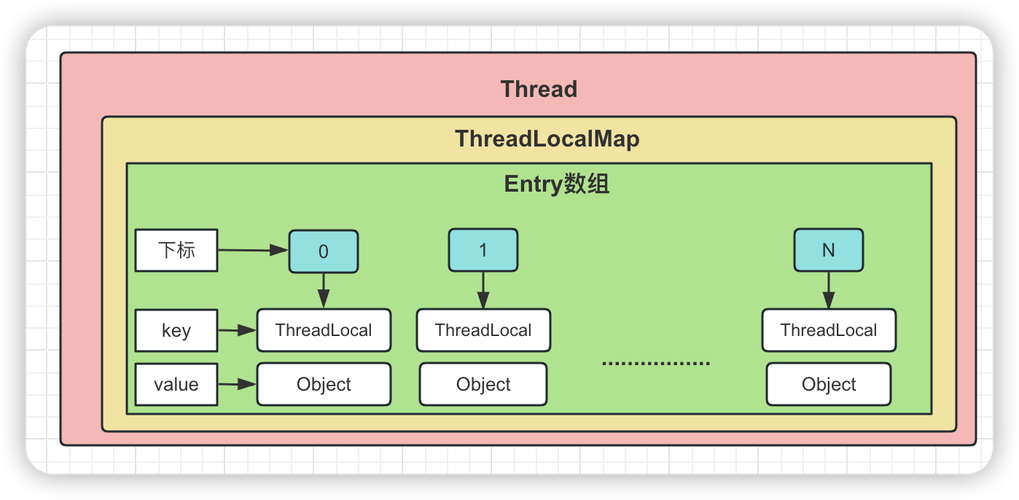
ThreadLocalitself is not a storage. It's a key.- Each
Threadobject in Java has an internal property, often called athreadLocalMap. - When you call
threadLocal.set(value), theThreadLocalinstance acts as the key, and thevalueyou provide is stored in the current thread'sthreadLocalMap. - When another thread calls
threadLocal.get(), it looks up the value in its ownthreadLocalMapusing the sameThreadLocalkey. Since it doesn't have an entry for that key, it getsnull.
Visual Representation:
// Thread 1
Thread {
    id: 1,
    threadLocalMap: {
        // Key:   (a ThreadLocal instance)
        // Value: "value-for-thread-1"
    }
}
// Thread 2
Thread {
    id: 2,
    threadLocalMap: {
        // Key:   (the same ThreadLocal instance)
        // Value: "value-for-thread-2"
    }
}
Key Methods
T get(): Returns the value in the current thread's copy of this thread-local variable. If the variable has no value for the current thread, it initializes it first by calling itsinitialValue()method.void set(T value): Sets the current thread's copy of this thread-local variable to the specified value.void remove(): Removes the current thread's value for this thread-local variable. This method is used to avoid memory leaks.protected T initialValue(): Called once from theget()method when the thread-local variable is accessed for the first time in a thread. The default implementation returnsnull. You can override this in a subclass to provide a custom initial value.
Better Practice: The withInitial Supplier (Java 8+)
Instead of subclassing ThreadLocal just to override initialValue, it's cleaner to use the static factory method withInitial.
// Creates a ThreadLocal that always has an initial value of "DEFAULT_USER"
private static final ThreadLocal<String> currentUser = ThreadLocal.withInitial(() -> "DEFAULT_USER");
// Now, currentUser.get() will never return null for a new thread.
String user = currentUser.get(); // user is "DEFAULT_USER"
The Famous Pitfall: Memory Leaks
This is the most critical issue with ThreadLocal. If you're not careful, you can cause a memory leak that can crash your application.
Why does it happen?
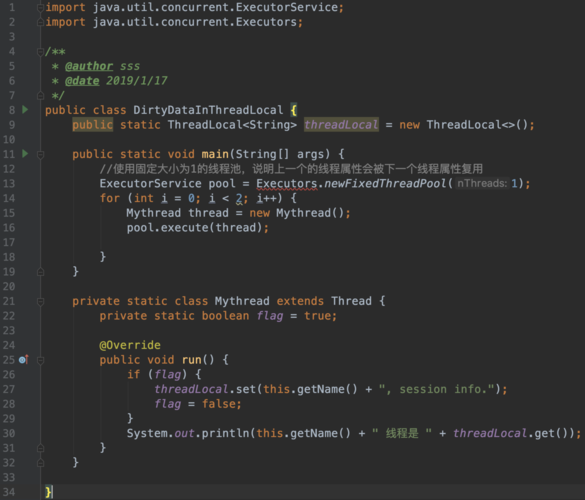
The memory leak occurs due to the interaction between the Thread object and its threadLocalMap.
- A
ThreadLocalvariable holds a strong reference to the key (theThreadLocalinstance itself). - The
threadLocalMapinside aThreadobject holds weak references to its keys (theThreadLocalinstances) but strong references to its values. - The problem arises with thread pools. In a web server, threads are created once and kept alive in a pool to be reused for many different requests.
The Leak Scenario:
- A request comes in. A pooled thread (
Thread-1) is assigned. - Your code sets a value in a
ThreadLocalvariable:threadLocal.set("some large object"). - The
threadLocalMapinsideThread-1now looks like:{ (threadLocal_key) -> (strong_ref_to_large_object) }. - The request finishes. Your code forgets to call
threadLocal.remove(). - The request is done, but
Thread-1is returned to the thread pool, ready for the next request. - The
threadLocalMapinThread-1still holds the strong reference to"some large object". This object cannot be garbage collected, even though the original code that put it there is long gone. - If this happens for many different requests, the memory of
Thread-1(and all other pooled threads) will grow indefinitely, eventually leading to anOutOfMemoryError.
How to Prevent It:
Always clean up after yourself. The best practice is to wrap the set() call in a try-finally block and call remove() in the finally block.
// GOOD PRACTICE
public void someMethod() {
    threadLocal.set("some value");
    try {
        // ... do your work ...
    } finally {
        threadLocal.remove(); // CRITICAL: Clean up the thread-local
    }
}
Common Use Cases
ThreadLocal is excellent for managing contextual state that is:
- Thread-specific: The data belongs to one thread.
- Implicitly available: You don't want to pass it as a parameter everywhere.
- Short-lived: The context is valid for the duration of a single task (e.g., a web request).
- Database Connections: In a web application, you can store the
Connectionobject for the current request in aThreadLocal. This ensures that all DAOs and services involved in processing that single request use the same connection, which is essential for transactions. - User/Session Context: Storing the currently logged-in user's ID, roles, or other session information. This is extremely common in web frameworks (like Spring's
RequestContextHolderwhich usesThreadLocalunder the hood). - Transaction Management: Similar to database connections, you can store a transaction object.
- Per-Thread IDs: Generating unique IDs that are specific to a thread, useful in logging or tracing.
Alternatives to ThreadLocal
While powerful, ThreadLocal has drawbacks. Consider these alternatives:
| Alternative | When to Use It | Pros | Cons |
|---|---|---|---|
| Explicit Parameters | When the context is explicitly needed by the methods in the call stack. | Clear, explicit, no hidden state, easy to reason about. | Can lead to "parameter spaghetti" in deep call stacks. |
| Functional Context (Java 8+) | When you can pass context as a method argument in a functional style. | Clean, composable, avoids hidden state. | Requires Java 8+ and a functional programming style. |
| Scoped Values (Java 21+ - Incubator) | The modern, safer replacement for ThreadLocal. |
Structured, immutable, scoped to specific execution units (virtual threads), less prone to leaks. | Very new, requires Java 21+ and virtual threads to be fully utilized. |
Summary
| Aspect | Description |
|---|---|
| What it is | A class that provides thread-local variables. |
| Core Idea | Each thread has its own private copy of the variable. |
| How it Works | Uses a threadLocalMap inside each Thread object, with the ThreadLocal instance as the key. |
| Main Benefit | Eliminates the need to pass context through deep call stacks. |
| Biggest Risk | Memory Leaks in thread pools if remove() is not called. |
| Golden Rule | Always call remove() in a finally block after you are done with a ThreadLocal variable. |