Of course! Let's dive deep into collections.OrderedDict in Python.
What is an OrderedDict?
An OrderedDict is a dictionary subclass that remembers the order in which its items were inserted. This is in contrast to a standard Python dictionary (which is an dict object), prior to Python 3.7, where the order of insertion was not guaranteed.
Key Takeaway:
- Python 3.7+: Standard
dictobjects are guaranteed to maintain insertion order. You no longer need anOrderedDictjust to preserve order. - Python 3.6 and earlier: Standard
dictobjects did not guarantee order.OrderedDictwas the only built-in way to have an ordered dictionary. - Why use it today? Even with ordered
dicts,OrderedDictstill has some unique features that make it useful in specific situations.
Basic Usage: Insertion Order
Let's see the difference in action. This example is most relevant for Python versions before 3.7, but the concept is the same.
from collections import OrderedDict
# --- Standard Dictionary (Python 3.6 or earlier) ---
# The order might not be what you expect.
print("--- Standard Dict (pre-3.7) ---")
regular_dict = {}
regular_dict['a'] = 1
regular_dict['b'] = 2
regular_dict['c'] = 3
regular_dict['d'] = 4
print(regular_dict)
# Possible output: {'a': 1, 'c': 3, 'b': 2, 'd': 4} (order not guaranteed)
# --- OrderedDict ---
# The order is always the order of insertion.
print("\n--- OrderedDict ---")
ordered_dict = OrderedDict()
ordered_dict['a'] = 1
ordered_dict['b'] = 2
ordered_dict['c'] = 3
ordered_dict['d'] = 4
print(ordered_dict)
# Guaranteed output: OrderedDict([('a', 1), ('b', 2), ('c', 3), ('d', 4)])
# --- Standard Dictionary (Python 3.7+) ---
# Now, the standard dict also preserves order.
print("\n--- Standard Dict (3.7+) ---")
modern_dict = {}
modern_dict['a'] = 1
modern_dict['b'] = 2
modern_dict['c'] = 3
modern_dict['d'] = 4
print(modern_dict)
# Guaranteed output: {'a': 1, 'b': 2, 'c': 3, 'd': 4}
Key Features and Methods of OrderedDict
OrderedDict has some special methods that a standard dict does not.
a. popitem(last=True)
This method removes and returns a (key, value) pair. The last parameter controls which item is popped.
popitem(last=True): Removes and returns the last item (LIFO - Last-In, First-Out). This behaves like a stack.popitem(last=False): Removes and returns the first item (FIFO - First-In, First-Out). This is a unique feature ofOrderedDict.
from collections import OrderedDict
d = OrderedDict()
d['first'] = 1
d['second'] = 2
d['last'] = 3
print("Original:", d)
# Original: OrderedDict([('first', 1), ('second', 2), ('last', 3)])
# Pop the last item (default)
item1 = d.popitem()
print("Popped last:", item1)
print("After pop last:", d)
# Popped last: ('last', 3)
# After pop last: OrderedDict([('first', 1), ('second', 2)])
# Pop the first item
item2 = d.popitem(last=False)
print("Popped first:", item2)
print("After pop first:", d)
# Popped first: ('first', 1)
# After pop first: OrderedDict([('second', 2)])
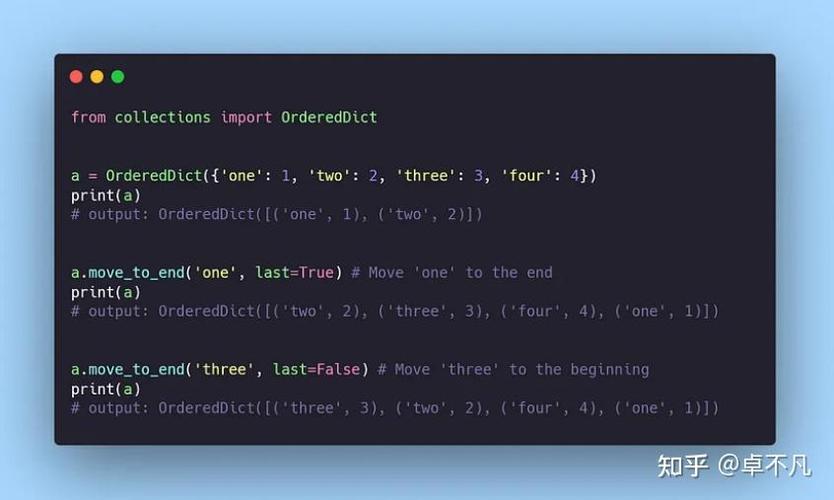
b. move_to_end(key, last=True)
This method moves an existing key to either the end or the beginning of the dictionary.
move_to_end(key, last=True): Moves the key to the end.move_to_end(key, last=False): Moves the key to the beginning.
from collections import OrderedDict
d = OrderedDict()
d['a'] = 1
d['b'] = 2
d['c'] = 3
print("Original:", d)
# Original: OrderedDict([('a', 1), ('b', 2), ('c', 3)])
# Move 'a' to the end
d.move_to_end('a')
print("Moved 'a' to end:", d)
# Moved 'a' to end: OrderedDict([('b', 2), ('c', 3), ('a', 1)])
# Move 'c' to the beginning
d.move_to_end('c', last=False)
print("Moved 'c' to beginning:", d)
# Moved 'c' to beginning: OrderedDict([('c', 3), ('b', 2), ('a', 1)])
When to Use OrderedDict in Modern Python (3.7+)
Since dict is ordered, you might wonder why you'd still use OrderedDict. Here are the main reasons:
Explicit Intent and Code Clarity
Using OrderedDict makes your code's intent crystal clear. You are explicitly telling other developers (and your future self) that the order of items is important and that you might be relying on features like move_to_end or popitem(last=False).
# This clearly states: "Order matters, and I'm using special methods."
from collections import OrderedDict
cache = OrderedDict()
# ... fill cache ...
Performance for Frequent Reordering
If your application involves a lot of moving items to the beginning or end of a dictionary, OrderedDict can be more efficient than a standard dict.
- Standard
dict: To move an item to the end, it must be deleted and re-inserted. This is an O(n) operation in the worst case because all subsequent items need to be shifted. OrderedDict: It maintains a doubly-linked list of keys. Moving an item to the beginning or end is an O(1) operation because it just involves changing a few pointers in the linked list.
# Performance comparison
import timeit
from collections import OrderedDict
setup_dict = "d = {i: i for i in range(1000)}"
setup_ordered_dict = "from collections import OrderedDict; d = OrderedDict({i: i for i in range(1000)})"
# Time for moving a key to the end
time_dict = timeit.timeit('d[500]; del d[500]; d[500] = 500', setup=setup_dict, number=10000)
time_ordered_dict = timeit.timeit('d.move_to_end(500)', setup=setup_ordered_dict, number=10000)
print(f"Standard dict move time: {time_dict:.4f} sec")
print(f"OrderedDict move time:  {time_ordered_dict:.4f} sec")
# OrderedDict will be significantly faster for this operation.
Legacy Code Compatibility
If you are maintaining code that was written for Python 3.6 or earlier, you will encounter OrderedDict. It's essential to understand how it works.
Comparison with dict
| Feature | Standard dict (Python 3.7+) |
collections.OrderedDict |
|---|---|---|
| Order Preservation | Guaranteed (Insertion) | Guaranteed (Insertion) |
popitem(last=False) |
❌ Not available | ✅ Available (pops first item) |
move_to_end() |
❌ Not available | ✅ Available (moves item to beginning or end efficiently) |
| Performance | General purpose, fast | Optimized for frequent re-ordering operations |
| Use Case | Default for all general use. | When order is critical and you need special LIFO/FIFO ops. |
Alternatives
For other kinds of ordered data structures, consider these:
-
dictwithvalues()oritems(): If you just need to iterate over values or items in a specific order, a moderndictis perfect.for value in my_dict.values():will respect the insertion order. -
collections.defaultdict: A subclass ofdictthat calls a factory function to supply missing values. It's also ordered in Python 3.7+.from collections import defaultdict d = defaultdict(list) d['a'].append(1) d['b'].append(2) d['a'].append(3) print(d) # defaultdict(<class 'list'>, {'a': [1, 3], 'b': [2]}) -
collections.ChainMap: Groups multiple dictionaries into a single, viewable-updatable mapping. It also preserves the order of its underlying mappings.
Summary
| Scenario | Recommended Data Structure |
|---|---|
| General purpose key-value storage. Order might be a bonus. | dict (Python 3.7+) |
| You need to explicitly signal that order is important. | collections.OrderedDict |
| You need to frequently move items to the front/back of a dictionary. | collections.OrderedDict (for performance) |
| You need a default value for a missing key. | collections.defaultdict |
| You are working with legacy code (Python < 3.7). | collections.OrderedDict |
| You need to group multiple dictionaries. | collections.ChainMap |