Excellent question! This is a classic dilemma for anyone starting their programming journey or choosing a language for a new project. The "best" language entirely depends on your goals, your background, and what you want to build.

Let's break down Java, Python, and C by comparing them across several key dimensions.
At a Glance: The TL;DR
| Feature | Python | Java | C |
|---|---|---|---|
| Best For | Beginners, Data Science, AI/ML, Web Backends, Scripting | Enterprise Apps, Android Apps, Large Systems, Web Backends | Operating Systems, Game Engines, Embedded Systems, High-Performance Code |
| Performance | Slowest (Interpreted) | Medium (Compiled to Bytecode) | Fastest (Compiled to Machine Code) |
| Learning Curve | Easiest | Medium | Hardest |
| Typing | Dynamic | Static | Static |
| Memory Mgmt | Automatic (Garbage Collector) | Automatic (Garbage Collector) | Manual (You control it) |
| Platform | "Write Once, Run Anywhere" (via Interpreter) | "Write Once, Run Anywhere" (via JVM) | "Write Once, Compile for Each Platform" |
| Key Strength | Readability, Vast Libraries | Portability, Robustness | Speed, Control, Power |
In-Depth Breakdown
Let's dive deeper into each language.
Python: The Jack-of-All-Trades
Python is famous for its simplicity and readability. It's designed to be a highly productive language, allowing developers to write and maintain codebases quickly.
Strengths:

- Beginner-Friendly: Its syntax is clean, English-like, and easy to learn. This makes it the top recommendation for absolute beginners.
- Massive Ecosystem: The Python Package Index (PyPI) has hundreds of thousands of libraries for almost anything you can imagine.
- Data Science & AI: NumPy, Pandas, Matplotlib, Scikit-learn, TensorFlow, PyTorch.
- Web Development: Django, Flask.
- Automation & Scripting: Great for writing small scripts to automate tasks.
- High Productivity: You can write a lot less code in Python to achieve the same result compared to Java or C.
Weaknesses:
- Slower Performance: Being an interpreted language, Python is significantly slower than compiled languages like C or Java. For most applications, this doesn't matter, but it's a bottleneck for CPU-intensive tasks.
- High Memory Consumption: Python's dynamic typing and ease of use can lead to higher memory usage.
- Global Interpreter Lock (GIL): In CPython (the standard implementation), the GIL is a mutex that allows only one thread to execute Python bytecode at a time. This prevents true parallel execution on multi-core processors for CPU-bound tasks.
Choose Python if:
- You are a complete beginner.
- You want to get into Data Science, Machine Learning, or Artificial Intelligence.
- You need to build a website backend quickly.
- You need to automate tasks or write scripts.
Java: The Enterprise Workhorse
Java is a class-based, object-oriented language designed to be as portable as possible. It runs on the Java Virtual Machine (JVM), which is a "write once, run anywhere" (WORA) platform.
Strengths:
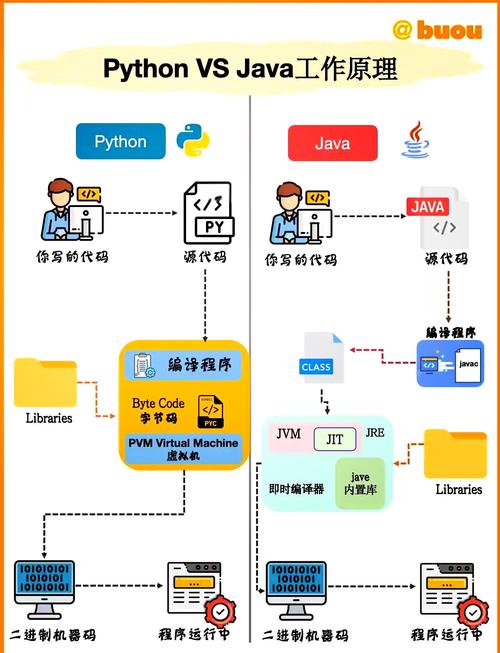
- Portability: The JVM is available for almost every operating system. You can compile your Java code once and run it anywhere the JVM is installed.
- Robust & Secure: Java has a strong type system, automatic memory management (garbage collection), and a vast set of built-in security features. This makes it a favorite for large, enterprise-level applications.
- Excellent for Large Systems: Its structure and performance make it suitable for building complex, scalable applications like banking systems and large web backends.
- Android Development: It was the primary language for Android app development for many years (though Kotlin is now the official recommended language).
Weaknesses:
- Verbosity: Java code can be very "boilerplate-heavy." You often need to write more lines of code to accomplish the same task as in Python.
- Slower Startup Time: Because it runs on the JVM, Java applications can have a slower startup time compared to native applications.
- More Complex Syntax: The syntax is more rigid and complex than Python's, making it less forgiving for beginners.
Choose Java if:
- You want to build large-scale, enterprise-grade applications.
- You are targeting the Android platform.
- You need a highly portable and robust backend for a website.
- You are working in a large team where structure and maintainability are critical.
C: The Foundation of Programming
C is a general-purpose, procedural programming language. It's one of the oldest and most influential languages, forming the basis for many other languages (including C++, Java, and C#). It gives you direct control over hardware memory.
Strengths:
- Blazing Fast Performance: C is compiled directly to machine code, making it the fastest of the three. There is no overhead from a virtual machine or interpreter.
- Low-Level Control: You have direct access to memory management and hardware pointers. This gives you ultimate power and efficiency.
- Foundation of Systems: It's the language used to write operating systems (like Windows and Linux), device drivers, and embedded systems.
- Efficient Memory Usage: Because you manage memory manually, you can create highly optimized applications with a small memory footprint.
Weaknesses:
- Extremely Difficult to Learn: The concepts of pointers, manual memory allocation (
malloc/free), and memory management are complex and a common source of bugs (like memory leaks and segmentation faults). - Unsafe: The power to directly access memory is dangerous. A small mistake can crash your entire application or create major security vulnerabilities.
- Slow Development Cycle: You have to compile your code every time you make a change, and managing memory manually is time-consuming and error-prone.
Choose C if:
- You are writing an operating system or a kernel.
- You are developing game engines or high-performance simulations.
- You are working with microcontrollers or other embedded systems.
- You need absolute maximum speed and control over memory usage (e.g., in financial trading systems).
How to Choose: A Decision Guide
Ask yourself these questions:
-
What is your primary goal?
- Learn to code easily? -> Python
- Build a website or mobile app? -> Java (or Python for a quick backend)
- Get into AI/Data Science? -> Python
- Build an operating system or game engine? -> C
-
What is your background?
- No programming experience? -> Python is the most gentle introduction.
- Some programming experience? -> Java is a great next step to learn strong structure and object-oriented principles.
-
What is the performance requirement?
- Speed is critical? -> C
- Speed is important, but not the absolute top priority? -> Java
- Speed is not a concern? -> Python
The Verdict
- For a beginner: Start with Python. It will teach you core programming concepts without the frustration of complex syntax and memory management.
- For a career in enterprise software or Android: Java is a powerhouse and a very valuable skill.
- For a career in systems programming, game development, or embedded systems: C is the fundamental language you must learn.
It's also worth noting that these languages are not mutually exclusive. Many developers know all three and use them for different purposes. For example, a Python web application might use a Java-based database and have some core logic written in C for performance.