Of course. "Java in Thinking" is a great way to approach the language, as it's not just about syntax but about the philosophy, design patterns, and "way of thinking" that makes Java so powerful and enduring.
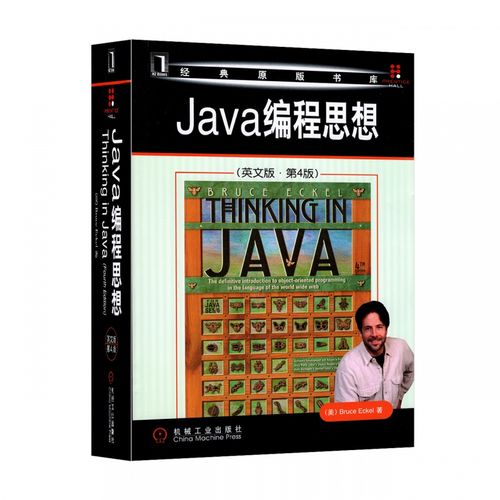
Let's break down "Java in Thinking" into several key areas:
The Core Philosophy: "Write Once, Run Anywhere" (WORA)
This is the foundational promise of Java and the entire Java Virtual Machine (JVM).
- The Thinking: Don't worry about the underlying operating system (Windows, Linux, macOS). Your code should be portable and run on any machine that has a JVM.
- How it Works:
- You write your Java code (
.javafile). - The Java compiler (
javac) compiles this code into bytecode (.classfile). This bytecode is not machine code for a specific processor; it's instructions for the JVM. - The JVM acts as an intermediary. It reads the bytecode and translates it into native machine code at runtime.
- You write your Java code (
- Analogy: Think of bytecode as a universal "language" for waiters. The JVM is the head chef in a kitchen. You write your order (your Java code) in a standard way. The waiter (compiler) takes your order to the kitchen. The head chef (JVM) understands the universal language and translates it into specific actions for the sous-chefs (the operating system) to execute. Your order doesn't need to be written in French for a French kitchen or Italian for an Italian one.
The "Thinking" Behind Object-Oriented Programming (OOP)
Java is fundamentally an OOP language. Thinking in Java means thinking in objects.
- The Thinking: Model your software after the real world. Break down a complex problem into smaller, self-contained, interacting "objects." Each object has its own state (data/attributes) and behavior (methods/functions).
Key OOP Concepts in Java:
-
Encapsulation: The idea of bundling data (fields) and the methods that operate on that data into a single unit (a class). You hide the internal state of an object and require all interaction to be performed through an object's methods.
 (图片来源网络,侵删)
- Java Thinking: Use
privatefor fields andpublicfor methods (getters/setters). This creates a "black box." Other code can use the object without knowing how it works internally. - Example: A
BankAccountobject. Thebalanceisprivate. You can't just domyAccount.balance = -1000000;. Instead, you must usemyAccount.deposit(500);ormyAccount.withdraw(100);. The methods enforce the rules.
- Java Thinking: Use
-
Inheritance: Creating a new class (child/subclass) that is a modified version of an existing class (parent/superclass).
-
Java Thinking: "Is-a" relationships. A
Dogis anAnimal. ASavingsAccountis aBankAccount. This promotes code reuse. You put common functionality in the parent class. -
Example:
class Animal {
    void eat() { System.out.println("Eating..."); }
}
class Dog extends Animal {
    void bark() { System.out.println("Woof!"); }
}
// A Dog object has both the eat() and bark() methods.
-
-
Polymorphism: The ability of an object to take on many forms. The most common use is allowing a child class object to be treated as its parent class type.
 (图片来源网络,侵删)
- Java Thinking: "One interface, multiple implementations." You can write code that works with the parent class type, and it will work with any child class, without needing to know the specific child type.
- Example:
Animal myDog = new Dog(); // A Dog object in an Animal reference
myDog.eat(); // This works. It calls the Animal's eat() method.
// myDog.bark(); // This will NOT compile! The compiler only knows 'myDog' is an Animal.
               // To call bark(), you must cast it back to a Dog.
-
Abstraction: Hiding complex implementation details and showing only the essential features of the object.
- Java Thinking: Focus on "what" an object does, not "how" it does it.
abstractclasses andinterfacesare tools for this. - Example: You know how to drive a car (
interface Carwith methodsstart(),steer(),stop()). You don't need to know the complex engineering of the internal combustion engine or the electric motor. That's the abstraction.
- Java Thinking: Focus on "what" an object does, not "how" it does it.
The "Thinking" Behind its Strong Type System and Safety
Java is statically typed and verbose. This is a feature, not a bug, from a safety and maintainability perspective.
- The Thinking: Explicitness over implicitness. Force the developer to declare their intentions clearly. Catch errors at compile-time, not at runtime when a user is using the application.
- How it Works:
- You must declare the type of every variable (
String name,int age). - The compiler checks types for you. If you try to assign a
Stringto anint, it will fail to compile.
- You must declare the type of every variable (
- Analogy: This is like a strongly typed language. You can't put a liquid (a
String) into a container meant for solids (anint). The compiler is the quality control check that happens before the product ships.
The "Thinking" Behind its Rich Ecosystem and Libraries
Java's motto is not just about the language, but the platform.
- The Thinking: Don't reinvent the wheel. Provide a massive, standardized library of pre-built, reliable code for almost any common task.
- Key Libraries/Frameworks:
- The Java Development Kit (JDK): Comes with the
java.lang,java.util,java.io, etc., packages. For collections, networking, file I/O, concurrency, and more. - The Spring Framework: The de facto standard for building enterprise applications. It promotes a "Dependency Injection" way of thinking, where components are given their dependencies from the outside, making them more modular and testable.
- Maven/Gradle: Build automation tools. They manage project dependencies (like downloading third-party libraries like Jackson for JSON parsing or Hibernate for database access) and handle the build process (compiling, testing, packaging).
- JUnit: The standard for unit testing in Java. The thinking here is "Test-Driven Development" (TDD) or at least writing tests to ensure your code works as expected and doesn't break when you change it.
- The Java Development Kit (JDK): Comes with the
The "Thinking" Behind Modern Java (Java 8+)
Java has evolved significantly. Modern Java introduces a "functional" way of thinking alongside its traditional OOP roots.
- The Thinking: Treat functions as "first-class citizens." Make code more concise, readable, and expressive, especially when dealing with collections of data.
- Key Concepts:
- Lambda Expressions: Allow you to treat functionality as a method argument, or as a code block. This is the heart of functional programming in Java.
- Old way:
new Thread(new Runnable() { public void run() { System.out.println("Hello"); } }); - New way (Lambda):
new Thread(() -> System.out.println("Hello"));
- Old way:
- The Stream API: A powerful way to process collections of objects in a declarative way (you describe what you want, not how to get it). It enables chaining of operations like
filter,map, andreduce.- Thinking: Instead of writing complex
forloops with nestedifstatements, you can express data transformations as a pipeline.List<Person> adults = people.stream() // 1. Create a stream .filter(p -> p.getAge() >= 18) // 2. Filter .collect(Collectors.toList()); // 3. Collect results
- Thinking: Instead of writing complex
- Lambda Expressions: Allow you to treat functionality as a method argument, or as a code block. This is the heart of functional programming in Java.
Summary: How to "Think" in Java
| Concept | The "Thinking" | Java Mechanism |
|---|---|---|
| Portability | Code should be independent of the OS. | JVM and Bytecode |
| Structure | Model the world as interacting objects. | Classes, Objects, OOP (Encapsulation, Inheritance, Polymorphism) |
| Safety | Be explicit and catch errors early. | Static Typing, Strong Compiler |
| Reusability | Leverage vast, tested libraries. | JDK, Maven/Gradle, Spring Framework |
| Conciseness | Write expressive, readable data pipelines. | Lambdas, Stream API (Modern Java) |
| Robustness | Build applications that don't crash easily. | Exception Handling, Garbage Collection |
To truly "think in Java," you must move beyond just learning the if statement or the for loop. You start to see problems in terms of objects, you design systems with interfaces and dependency injection, and you leverage the power of the JVM and its ecosystem to build scalable, maintainable, and robust software.