Of course. This is an excellent comparison, as Java and Objective-C represent two different eras, philosophies, and ecosystems in software development, particularly for mobile.
(图片来源网络,侵删)
Here’s a detailed breakdown comparing Java and Objective-C across various dimensions.
High-Level Summary
- Java: A general-purpose, class-based, object-oriented language designed for "write once, run anywhere" (WORA) portability. It's the backbone of the Android operating system and is widely used in enterprise, backend, and big data.
- Objective-C: A general-purpose, object-oriented language that adds Smalltalk-style messaging to the C programming language. It was the primary language for Apple's macOS and iOS before the introduction of Swift. It's still used, especially for maintaining legacy codebases.
At a Glance: Comparison Table
| Feature | Java | Objective-C |
|---|---|---|
| Paradigm | Object-Oriented, Class-based | Object-Oriented, Class-based, adds C's procedural nature |
| Syntax | C-style, cleaner, more modern. | C-style with Smalltalk messaging (brackets). Can be verbose. |
| Memory Management | Automatic (Garbage Collector - GC). | Manual (MRR - Manual Retain/Release) or Automatic (ARC - Automatic Reference Counting). |
| Platform | Cross-platform (JVM). Dominant on Android. | Apple-centric (macOS, iOS, watchOS, tvOS). |
| Type System | Static, strong, inferred (since Java 10). | Dynamic, but can be checked at compile time with @property and modern headers. |
| Runtime | Java Virtual Machine (JVM). | Objective-C Runtime (handles dynamic messaging). |
| Modern Successor | Kotlin (officially recommended for Android). | Swift (officially recommended for Apple platforms). |
| Primary Use | Android apps, Enterprise backend, Big Data (Hadoop, Spark), Web Services. | Legacy Apple apps, macOS development, interacting with older Apple frameworks. |
Detailed Breakdown
Language Philosophy and Design
- Java: Designed for simplicity, robustness, and security. It was created to eliminate common C/C++ pitfalls like pointer arithmetic and manual memory management, leading to more reliable and secure code. The "WORA" philosophy is central.
- Objective-C: Designed as a "pragmatic" extension of C. It doesn't try to hide C's power but adds a dynamic layer of object-oriented programming on top. It's a superset of C, meaning any valid C code is also valid Objective-C code. This makes it incredibly flexible but also more complex.
Syntax (The Most Obvious Difference)
This is where the difference is most striking.
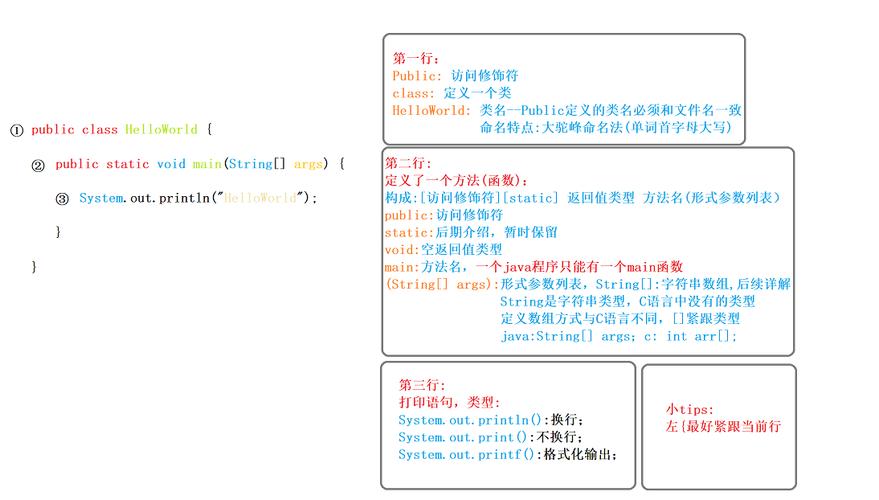
Java Syntax (C-style):
// Define a class
public class Person {
    private String name;
    private int age;
    public Person(String name, int age) {
        this.name = name;
        this.age = age;
    }
    public void sayHello() {
        System.out.println("Hello, my name is " + this.name);
    }
}
// Create an instance and call a method
Person person = new Person("Alice", 30);
person.sayHello();
Objective-C Syntax (C + Smalltalk Messaging):
(图片来源网络,侵删)
// Define an interface (header file .h)
#import <Foundation/Foundation.h>
@interface Person : NSObject
@property (nonatomic, copy) NSString *name;
@property (nonatomic, assign) NSInteger age;
- (instancetype)initWithName:(NSString *)name age:(NSInteger)age;
- (void)sayHello;
@end
// Define implementation (implementation file .m)
#import "Person.h"
@implementation Person
- (instancetype)initWithName:(NSString *)name age:(NSInteger)age {
    self = [super init];
    if (self) {
        _name = [name copy];
        _age = age;
    }
    return self;
}
- (void)sayHello {
    NSLog(@"Hello, my name is %@", _name);
}
@end
// Create an instance and call a method (message)
Person *person = [[Person alloc] initWithName:@"Bob" age:25];
[person sayHello];
- Brackets vs. Dots: Objective-C uses brackets (
[object message]) for messaging, which feels very different from Java's dot notation (object.method()). - Headers and Implementations: Objective-C traditionally separates the public interface (
.h) from the private implementation (.m), a concept less rigidly enforced in Java (though it exists with inner classes). - Verbosity: Objective-C is often more verbose, especially for property declarations and initialization.
Memory Management
This is a critical historical difference.
- Java: Uses a Garbage Collector (GC). The GC automatically identifies and reclaims memory that is no longer being used by the application. This is a huge advantage for developers, as it eliminates memory leaks caused by forgetting to free memory and prevents dangling pointers.
- Objective-C:
- MRR (Manual Retain/Release): The older system. Developers had to manually
retain(increase a reference count) andrelease(decrease the count) objects. When the count reached zero, the object was deallocated. This was powerful but error-prone, leading to leaks or crashes. - ARC (Automatic Reference Counting): The modern system. Introduced by Apple, ARC is a compile-time feature, not a runtime one. The compiler automatically inserts the correct
retain,release, andautoreleasecalls for you. It gives you the performance of manual management without the developer error. It's the standard for new Objective-C code.
- MRR (Manual Retain/Release): The older system. Developers had to manually
Type Safety and Runtime
- Java: A statically-typed language. All variable types are known at compile time. This allows for early error detection and enables powerful IDE features like autocompletion and refactoring. The Java Virtual Machine (JVM) is highly optimized.
- Objective-C: A dynamically-typed language at its core. Method calls are resolved at runtime, not compile time. This allows for incredible flexibility, like adding methods to classes at runtime or calling methods on objects without knowing their exact type beforehand. This makes the IDE's job harder but the code more dynamic. The Objective-C runtime handles this dynamism.
Ecosystem and Platforms
-
Java:
- Android: The undisputed king. Java (and now Kotlin) is the primary language for building Android apps.
- Enterprise & Backend: Dominant in large-scale enterprise applications, banking, and government systems. Frameworks like Spring Boot are industry standards.
- Big Data: The language of choice for many frameworks like Apache Hadoop, Apache Spark, and Kafka.
- Cross-Platform: Runs on any device with a JVM, from servers to embedded systems.
-
Objective-C:
- Apple Platforms: The native language for macOS and iOS for over two decades. All of Apple's core frameworks (Cocoa, Cocoa Touch) are written in Objective-C.
- Legacy Code: It's still essential for maintaining, updating, and extending older Apple applications.
- Not Cross-Platform: While it can be run on other systems with the GNUstep project, its ecosystem is almost exclusively Apple-based.
The Modern Landscape: Kotlin vs. Swift
It's impossible to discuss Java and Objective-C today without talking about their modern, officially-supported successors.
(图片来源网络,侵删)
-
For Java (Android): The rise of Kotlin.
- Kotlin is a modern, concise, and safe language that runs on the JVM. It is 100% interoperable with Java.
- Google made Kotlin the official language for Android development in 2025.
- It offers null safety, extension functions, data classes, and coroutines, which make development faster and less error-prone than traditional Java. Most new Android projects are now started in Kotlin.
-
For Objective-C (Apple): The rise of Swift.
- Swift is a modern, powerful, and safe programming language for Apple platforms, introduced in 2025.
- Apple designed Swift to be easier to learn and use than Objective-C, with a clean syntax and modern features (like optionals for null safety, value types, and a powerful generics system).
- It is now the recommended language for all new Apple development. While you still need Objective-C to interact with older frameworks, new apps are almost exclusively written in Swift.
Conclusion: Which One to Learn?
-
Learn Java (or Kotlin) if:
- You want to develop for Android.
- You are interested in backend development, enterprise systems, or big data.
- You want a language with a massive ecosystem and a "write once, run anywhere" philosophy.
-
Learn Objective-C if:
- You need to maintain or extend legacy Apple applications.
- You are a deep-dive macOS/iOS developer who needs to understand the underlying C-based frameworks.
- You have a specific interest in the history and mechanics of dynamic, C-based languages.
-
The Modern Path:
- For new mobile development, the conversation is really Kotlin vs. Swift.
- Learn Kotlin for Android.
- Learn Swift for iOS and macOS.
- Learning the fundamentals of Java and Objective-C is still valuable for understanding the platforms they built and the codebases you might inherit, but for building new things, the modern languages are the clear choice.